
AI-integrated mobile apps turn conventional applications into data-driven solutions, while analysing and personalising user experience and increasing engagement. using emerging AI technologies like machine learning and NLP, you can retain customers, optimise processes, and generate revenues.
The App Development Ecosystem in Australia has Changed. Have You?
Why do some mobile products dominate markets while thousands of applications disappear from app stores within months of launch?
The answer lies in intelligent product architecture.
Mobile apps and software are evolving beyond traditional mobile apps development across Australia. App developers now deploy AI-powered mobile platforms that analyse behavioural data, predict user intent, and personalise digital experiences accordingly.
- A retailer in Melbourne increased repeat purchases by 34%, leveraging an AI recommendation engine.
- The Australian AI market will reach US$14.53 billion by 2030, growing at a CAGR of 27.75% annually (Statista, 2025)
- The global AI app industry generated $18.5 billion in revenue in 2025, a 180% increase year over year (Business of Apps, 2025)
- Generative AI app downloads reached 1.5 billion in 2024, a 92% increase year over year across the world (Sensor Tower, 2025)
- Apps integrating AI features received 17 billion downloads in 2024, representing 13% of all app downloads globally (Sensor Tower, 2025)
- According to PwC Australia, artificial intelligence could contribute $315 billion to the Australian economy by 2030.
- Smartphone penetration in Australia exceeds 90% nationally, creating a vast addressable market for intelligent mobile experiences (Statista, 2025)
Mobile applications now represent the primary interface between companies and customers. Integrating emerging AI technologies converts a traditional mobile app into an adaptive digital platform capable of learning from user behaviour and continuously optimising user engagement.
That's why Founders, CTOs, and product leaders prioritise app development backed by AI, ensuring measurable outcomes in:
- User Engagement
- Customer Retention
- Operational Efficiency
- Recurring Digital Revenue
Businesses that adopt intelligence into mobile apps scale faster, retain more users, and generate measurably higher ROI. Businesses that ignore AI-powered mobile development lose ground to those that embrace it.
This is not a trend. This is the new benchmark.
By the end of this article, you will understand how AI mobile app development works at a technical and strategic level, and exactly how to deploy AI capabilities to increase downloads, recurring revenue, engagement, and long-term competitive advantage across the Australian market.
What Makes an AI-Powered Mobile App Different from a Traditional App
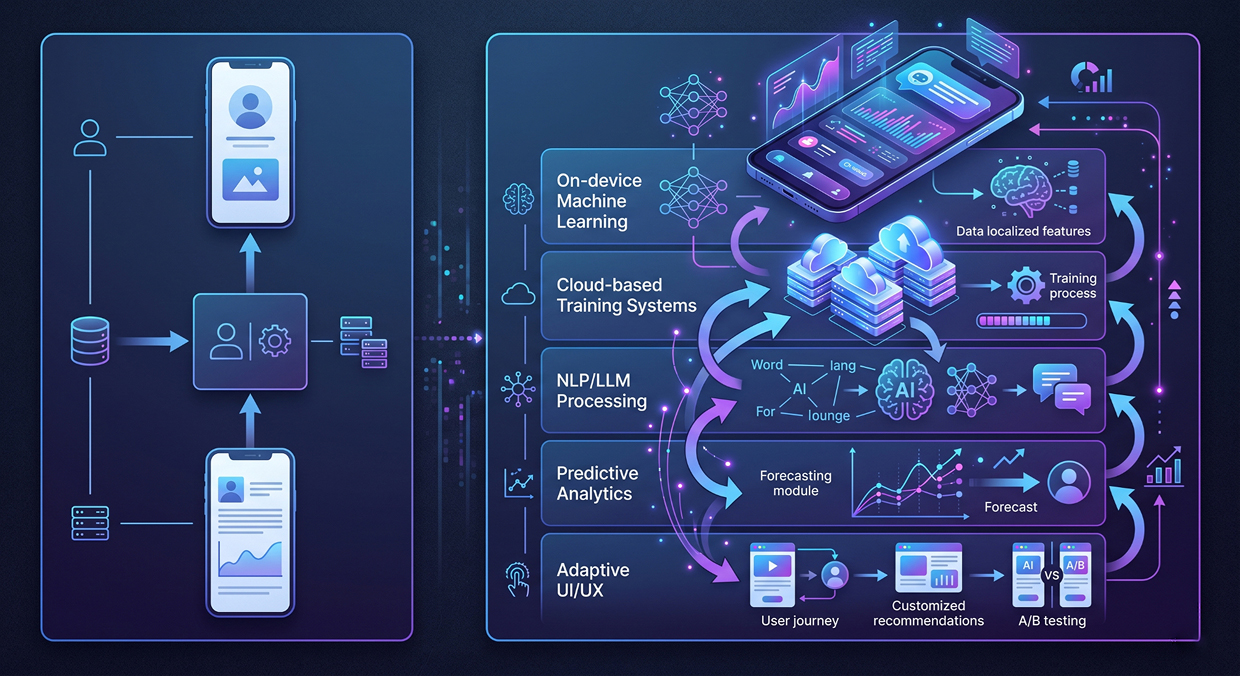
Not every app with a chatbot qualifies as AI-powered. The distinction matters enormously, both technically and commercially. A high-performing AI-driven mobile application is an intelligent system built on machine learning models, natural language processing (NLP) engines, predictive analytics pipelines, and adaptive UI/UX frameworks. The core technical architecture of a highly-responsive AI mobile app includes:
- On-device ML inference, allowing the mobile app to process intelligence locally, reduce latency, and protect user data without sending every request to the cloud.
- Cloud-based model training via platforms, including AWS SageMaker or Google Vertex AI, where large datasets are processed, and models are continuously retrained on new user data.
- NLP and Large Language Model (LLM) integration, support conversational interfaces, semantic search, and context-aware responses, especially in applications where user interaction depends on natural language inputs.
- Predictive analytics layers, transforming historical and real-time data into decision support.
- Adaptive UI/UX systems, where the mobile app adjusts layout, content priority, and feature visibility based on each user behaviour.
Meaning that an AI-powered app does not simply respond to user inputs but learns, predicts, adapts, and acts, making every interaction smarter than the last.
What Major AI Capabilities Are Powering Next-Generation Mobile Apps in Australia?
1. ML-Driven Personalisation
Machine learning (ML) algorithms analyse behavioural signals, including purchase frequency, session duration, feature interaction sequences, time-of-day patterns, and geolocation, to build individual user profiles. Machine learning personalisation creates compounding value. The longer the product operates, the more accurate the model becomes.
- 60% of consumers become repeat buyers after receiving a personalised experience
- AI-driven personalisation reduces customer churn by 28% as users develop stronger attachment to the brand
- Early AI adopters in personalisation show 41% better retention metrics than businesses that delay AI implementation
2. NLP and Conversational AI
NLP integration transforms mobile apps from transactional tools into conversational interfaces. Applications backed by AI in Australia incorporate NLP systems that understand regional dialects, Australian English colloquialisms, and industry-agnostic terminology, a critical capability for local market relevance.
NLP deployments in Australian mobile apps include:
- Agentic AI customer service, where the AI system not only retrieves answers from a database but, validates user context, and delivers personalised responses autonomously.
- Voice recognition interfaces supporting hands-free operation for logistics drivers, healthcare practitioners, and field service technicians.
- Semantic search, allowing users to query complex databases in natural language rather than navigating hierarchical menus.
Organisations deploying conversational AI report:
- 25% increases in customer satisfaction
- 67% reduction in customer support handling time
3. Predictive Analytics and Demand Forecasting
Predictive analytics engines process historical transaction data, seasonal patterns, geographic signals, and real-time market insights to generate business intelligence directly within the mobile interface. Australian businesses use predictive analytics in mobile apps to identify trends before acting.
The business outcomes from predictive analytics in mobile apps include:
- A 5% improvement in customer retention boosts profits by 25% to 95% (Bain and Company via Ringly, 2026)
- McKinsey reports companies using personalisation in customer interactions see 5% to 15% revenue increases (McKinsey via NiCE, 2025)
- Customer-centric organisations report 41% faster revenue growth (Forrester via Ringly, 2026)
- Streaming apps with AI-driven content curation report a 19% improvement in watch time per session (SQ Magazine, 2025)
4. Computer Vision and Visual Intelligence
Computer vision technology allows mobile apps to recognise images and analyse visual content. Computer vision capabilities powered by convolutional neural networks (CNNs) deployed via CoreML or TensorFlow Lite enable mobile apps to process and understand visual information in real time.
Retail platforms deploy visual search tools enabling users to identify products directly through images. Logistics platforms use computer vision for asset monitoring and inspection workflows.
- Visual search in retail accelerated purchase intent by up to 25%, enabling customers to photograph products and retrieve catalogue matches instantly.
- AR-based apps in retail and real estate record 22% increases in engagement time
- Quality control AI vision systems in manufacturing achieve defect detection accuracy rates exceeding 98%.
- Real-time identity document parsing in fintech accelerates verification while reducing exposure to fraud signals.
5. Cross-Platform AI Deployment Across iOS and Android
Modern AI mobile app development leverages cross-platform frameworks including React Native and Flutter, blended with platform-agnostic AI libraries, CoreML for iOS, ML Kit for Android, to deploy consistent intelligent user experiences across devices without developing separate code.
Cross-platform frameworks now power over 60% of global app developments, ensuring higher efficiency and faster time-to-market (SQ Magazine, 2025). Our cross-platform AI architecture reduces development costs by 30 to 40% compared to building separate native applications, while maintaining full access to on-device AI capabilities across iOS and Android.
What the Best Australian AI Mobile App Development Partner Looks Like
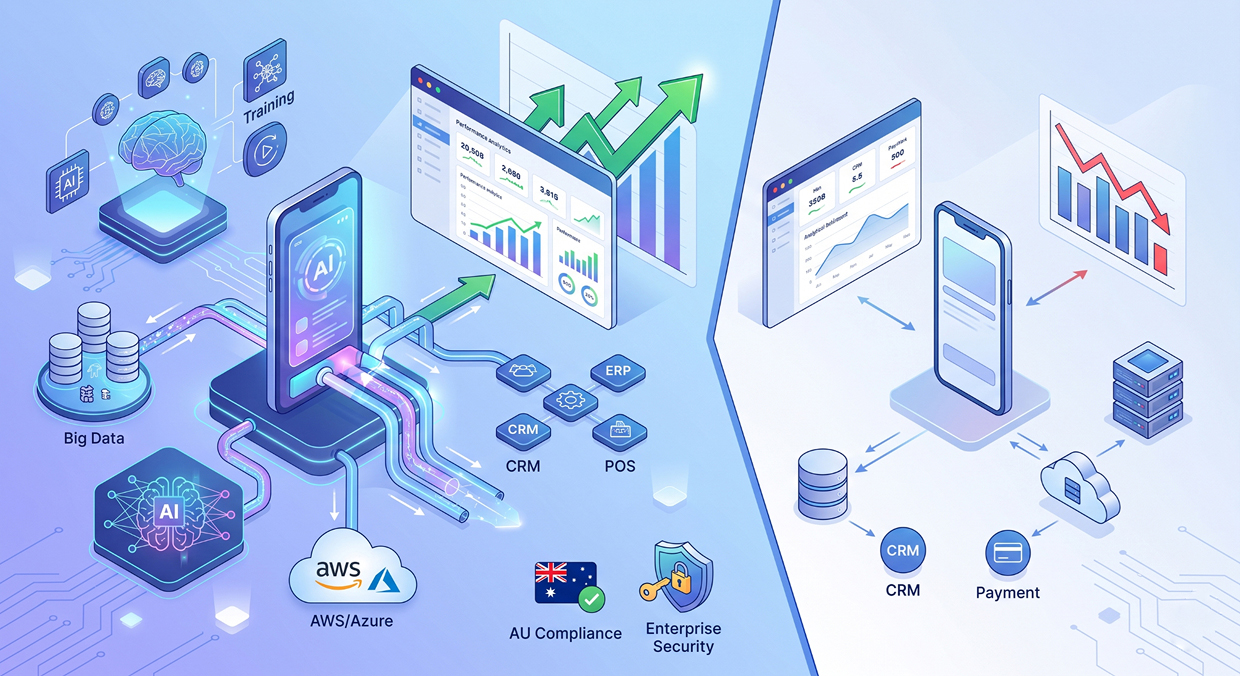
Selecting the right development partner is the single highest leverage decision in an AI mobile app project. The difference between a skilled AI mobile app development company and a generalist development shop measures in months of rework, hundreds of thousands in wasted investment, and missed market windows.
The right App development partners will have:
- Proven ML and AI development capability to build and deploy models, design training pipelines, and manage production environments across CoreML, TensorFlow Lite, and cloud-based ML frameworks, not just integrate third-party APIs.
- Industry-specific experience and regulatory expertise, including Privacy Act 1988 compliance, My Health Records Act requirements for healthcare applications, and APRA guidelines for financial services apps.
- Full-stack AI mobile architecture competency, including cloud architectures, enterprise integration across CRM, ERP, and POS systems, and cross-platform app deployment.
- Iterative development approach, recognising AI models improves with real user data over time and implementing continuous learning pipelines rather than static one-time deployments.
- Transparent performance metrics and improvement plans across engagement, retention, conversion, and operational efficiency.
Frequently Asked Questions
Traditional mobile apps follow predefined rules and static workflows written during development. AI mobile apps integrate machine learning, NLP, predictive analytics, and adaptive interfaces to analyse user behaviour, automate decisions, and continuously improve personalisation, engagement, and performance.
Yes, you can integrate AI features into an existing mobile app without rebuilding the entire system. Experienced mobile app developers like AppMart extend existing APIs, data pipelines, and backend services to incorporate ML-driven personalisation, NLP chatbots, predictive analytics, and automation features.
AI mobile apps must comply with Australia’s Privacy Act 1988, align with the My Health Records Act for healthcare applications, and comply with APRA regulatory guidelines for financial services.
Experienced mobile app developers like AppMart implement on-device ML inference and secure data pipelines from the ground up to meet compliance requirements.