
Stop. If you're planning to build an app in Australia this year, the number in your head right now is probably wrong.
We've spent over a decade building apps across fintech, healthcare, logistics, e-commerce, and almost every industry you can think of. The one thing that kills great ideas before they even launch is founders walking in with the wrong budget expectations not because they're careless, but because nobody in this industry is being straight with them.
Here's what app development actually costs. An MVP development in Australia starts at $15,000. That's the real figure for something that works and doesn't embarrass you on launch day. A mid-complexity app with custom features and a proper backend runs $50,000 to $150,000. An enterprise platform with AI capabilities and serious infrastructure starts at $150,000. And if you're building at that scale, plan for it to grow past $400,000.
How Much Does an App Cost in Australia, Really?
Your budget can vary by 35% just because of the platform you choose. In 2026, Flutter or React Native for cross-platform apps is not a compromise, but rather the most prudent decision.
It's the smart call, and the industry has moved there for good reason. Your team setup matters just as much: Australian developers bill between $150 and $250 an hour for senior, agency-grade work.
A globally distributed offshore team at a comparable skill level runs $20 to $60. That gap is real, and it's exactly why hybrid delivery models exist. But it's also why a cheap hourly rate on its own doesn't tell you what a project will actually cost by the time it ships.
Post-launch costs (maintenance, scaling, performance updates) are what almost nobody budgets for. Put aside 15–20% of your development cost every year, or you'll feel that gap right when your product starts gaining traction.
The AI conversation nobody has early enough. Every founder wants intelligence incorporated into their product in 2026, and that's the right instinct. But AI isn't a feature you bolt on at the end. It's an architectural decision that shapes your entire backend and your long-term costs. Getting that right at the start saves you from rebuilding half your product a year later.
The rest of this guide breaks down exactly where those numbers come from, stage by stage, so you can plan a real budget instead of guessing at a bracket.
App Development Cost Australia by App Type
| App Type | Cost Range (AUD) | Typical Timeline |
|---|---|---|
| Simple app / MVP | $15,000 – $50,000 | 6–12 weeks |
| Medium-complexity business app | $50,000 – $150,000 | 3–6 months |
| Complex / enterprise app | $150,000 – $400,000+ | 6–12+ months |
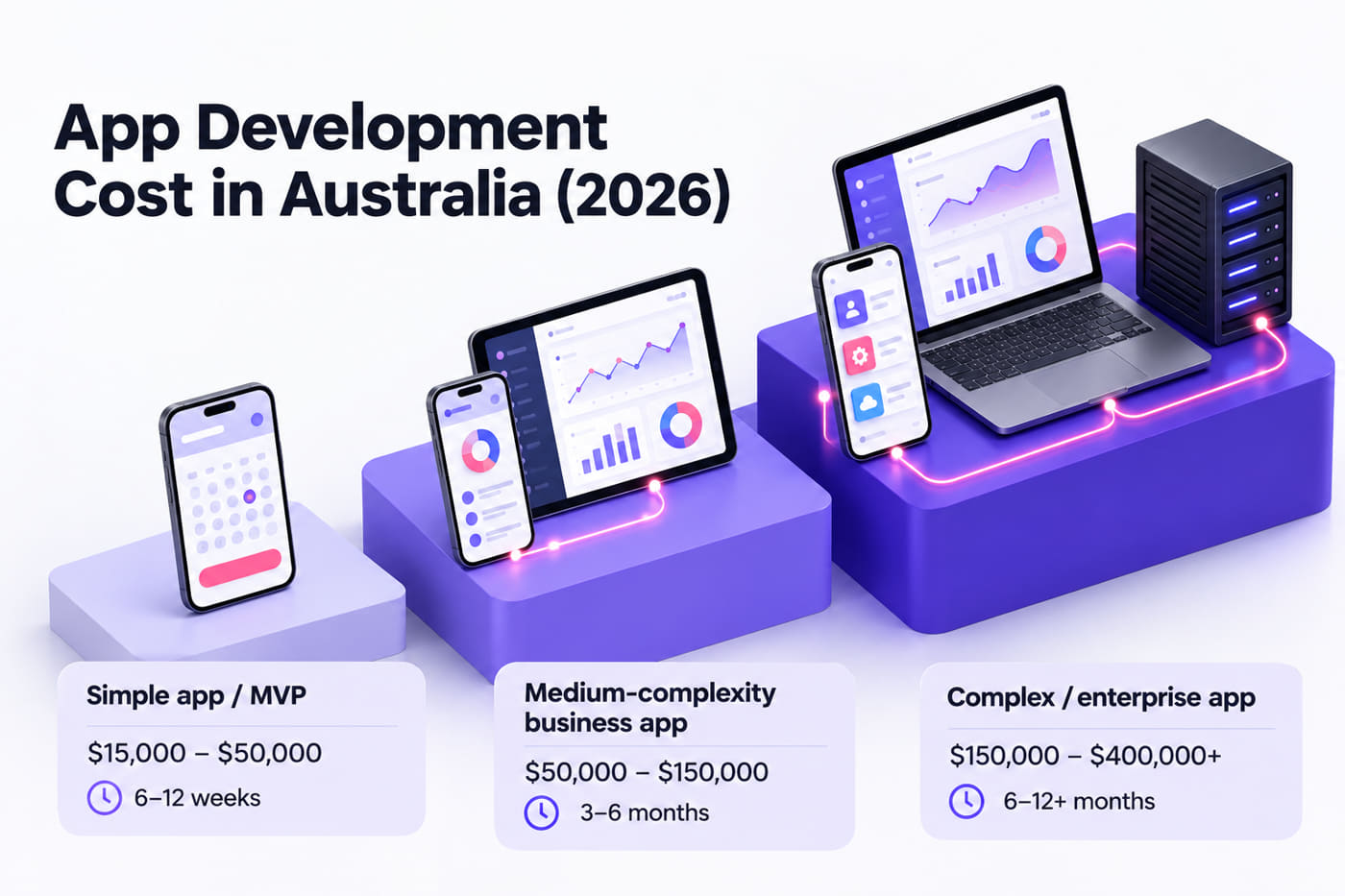
A simple app usually covers a handful of core screens, basic login, and a standard backend: think a booking form, a loyalty card, or a straightforward informational app. A medium-complexity build adds user accounts and roles, payments, an admin dashboard, and third-party integrations, which is where most real customer-facing business apps land.
A complex build layers in real-time features, multiple system integrations, and enterprise-grade security, and is typical for marketplaces, fintech platforms, and logistics systems. Some enterprise platforms with heavy compliance and custom infrastructure needs can run well past $400,000.
These ranges reflect the middle of the Australian market. A handful of premium agencies and offshore-heavy shops sit outside them at both ends, which is exactly why a scoped quote against your actual requirements matters more than any published range, including this one.
App Development Hourly Rate Australia: What Developers Actually Charge
App development pricing Australia-wide ultimately comes down to hours multiplied by rate:
| Developer Type | Hourly Rate (AUD) |
|---|---|
| Offshore (India, Eastern Europe, Philippines) | $20 – $60 |
| Junior developer | $80 – $120 |
| Mid-level developer | $120 – $180 |
| Senior developer / agency team | $150 – $250 |
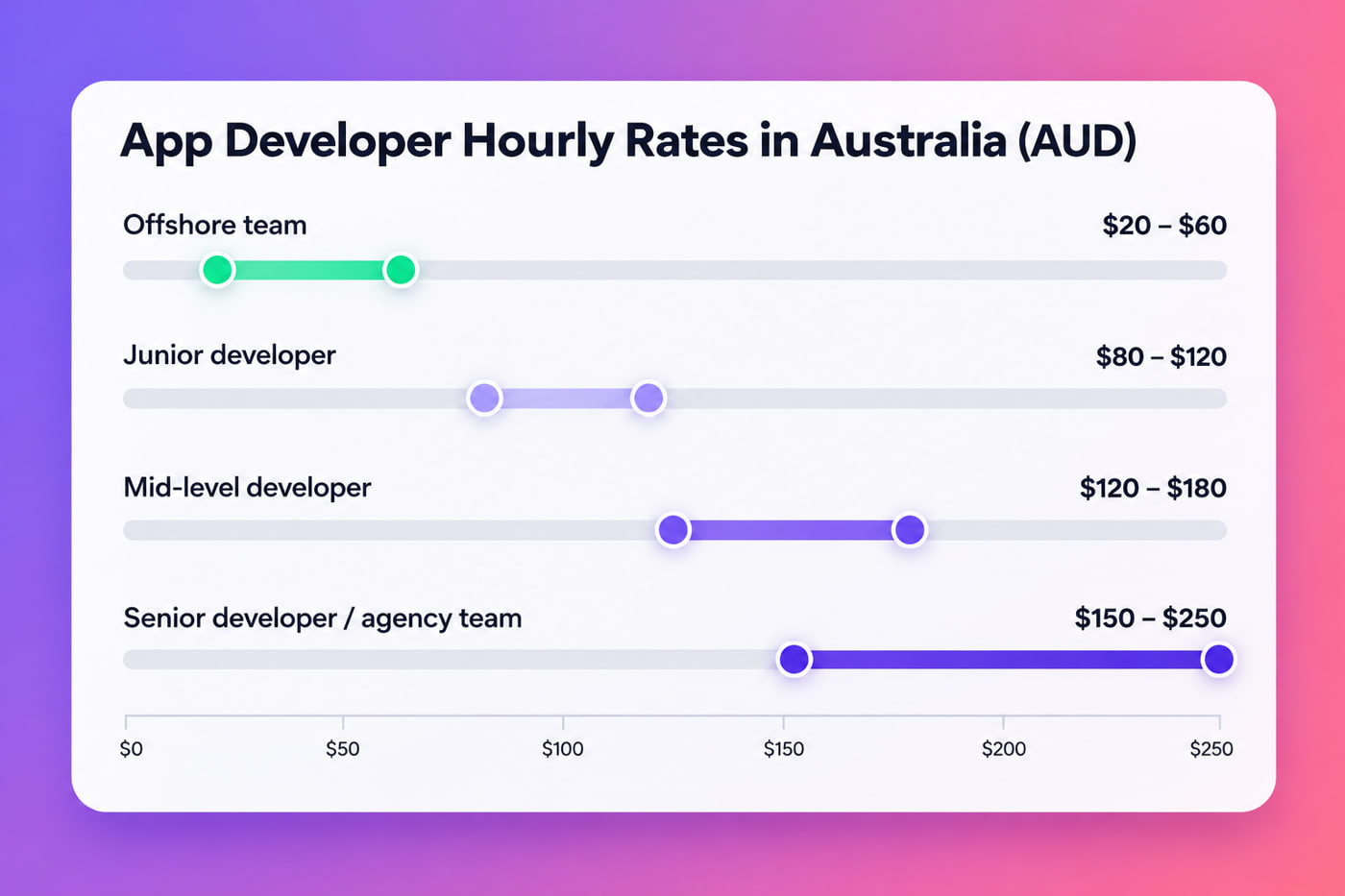
Offshore rates look attractive on paper, and for a well-scoped, low-risk build they can work well. But a cheap app development Australia search often skips the trade-offs: time-zone gaps that slow feedback loops, communication friction, and rework when requirements get lost in translation. Those costs tend to show up later as delays and a second round of fixes, not as a line item in the original quote, which is exactly why the lowest bid in a comparison isn't always the cheapest project by the time it ships.
What Drives Mobile App Development Cost in Australia?
Platforms (iOS, Android, or both)
iOS app development cost and Android app development cost are broadly similar per platform, but building two separate native apps roughly doubles design, development, and QA effort. Cross-platform frameworks such as Flutter or React Native let one codebase serve both platforms, which is why AppMart builds most business apps this way. It typically saves 20–35% against two native builds without a meaningful hit to performance for most use cases. Native development still makes sense when an app depends on deep, platform-specific hardware access or needs to squeeze out maximum performance.
Number of screens and user flows
Every screen needs its own design, build, and test cycle. A basic app might run 5–10 screens; a business app with dashboards, reporting, settings, and admin tools can easily run to 30–50+. Screen count is one of the most reliable proxies for scope, and it's also one of the easiest things to under-count when a project is first described in a single sentence.
Backend, APIs and integrations
Most of an app's cost sits behind the screen, in the backend that manages users, data, and business logic. Connecting to payment gateways, CRM or ERP systems (Salesforce, Xero, MYOB), mapping services, or legacy internal systems each adds its own design, build, and testing cost. Typically $3,000 to $20,000 per integration, depending on how custom the connection needs to be.
Design
Working from proven UI component libraries is faster and cheaper than a fully bespoke design system with custom animation and unique interaction patterns. Both can look polished, but bespoke UI/UX design work adds hours across every screen. Often $10,000 to $50,000+ depending on screen count and fidelity.
Data, security and compliance
Apps handling health, financial, or personal data carry obligations under the Privacy Act 1988 and the Australian Privacy Principles (APPs). Secure authentication, encryption, audit logging, and access control aren't optional once sensitive data is involved, and they add measurable, non-negotiable cost to the backend build.
Ongoing maintenance
An app isn't a one-off purchase. Budget roughly 15–20% of the build cost per year for OS compatibility updates, bug fixes, security patches, and hosting. On a $60,000 build, that's around $9,000–$12,000 annually, a genuine app maintenance cost Australia businesses need to plan for from day one, not discover after launch.
Where Does Your App Development Budget Actually Go?
Across a typical build, the spend splits fairly consistently by stage, regardless of the total project size:
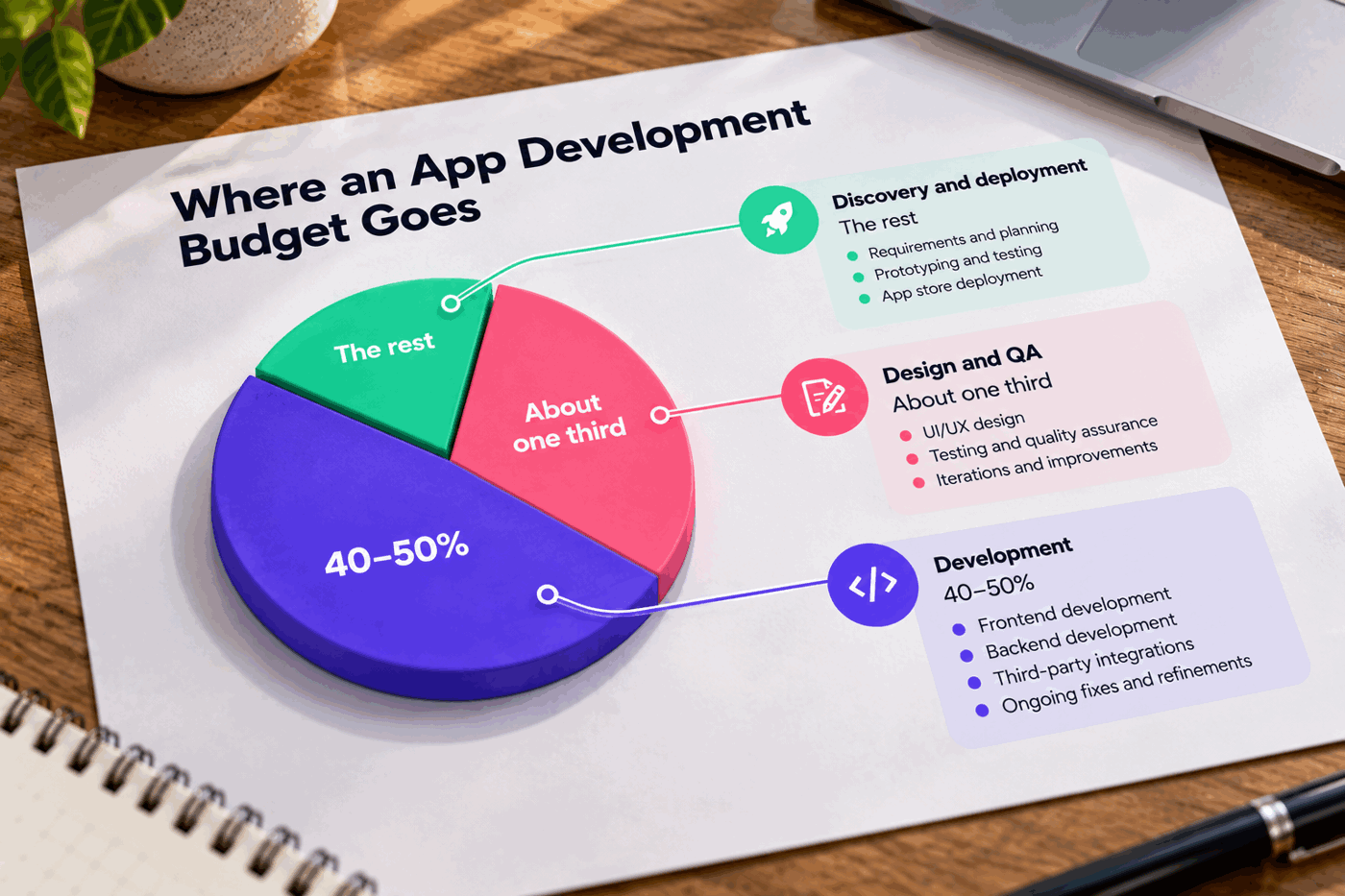
Development (the actual coding of features, backend, and integrations) is consistently the largest line item, at roughly 40–50% of the total. Design and QA together account for close to a third. Discovery and deployment are smaller, but skipping or rushing discovery is the single most common cause of budgets blowing out later, because problems found in week one cost far less to fix than problems found in month five.
What Hidden App Development Costs Do Australian Businesses Forget to Budget For?
The build quote is rarely the whole budget. A few running costs sit outside the initial number:
- App store fees - The Apple Developer Program costs $149 AUD per year (confirmed via Apple's developer enrolment pricing). The Google Play Console charges a one-off developer registration fee of roughly $30–40 AUD. If you sell digital goods in-app, both stores also take a commission on transactions.
- Hosting and cloud infrastructure - Backend hosting typically runs from $50 to several thousand dollars a month depending on user volume, data storage, and traffic. This scales with your app's success, which is a good problem to have but still needs budgeting.
- Third-party service fees - Payment processors, SMS and push notification services, and mapping APIs usually charge on usage, separate from your development invoice.
Can the R&D Tax Incentive Lower Your App Development Cost in Australia?
Australian businesses building genuinely novel software may be able to offset a meaningful share of development costs through the Research and Development (R&D) Tax Incentive, jointly administered by AusIndustry and the ATO. As of the current 2026 rates, companies with aggregated turnover under $20 million can claim a refundable tax offset of 43.5% on eligible R&D expenditure (their corporate tax rate plus an 18.5% premium), a genuine cash refund if the company is in a tax loss position.
Building a novel machine learning model, an unproven integration architecture, or an experimental technical approach can qualify; wiring up a CRM integration using a documented API generally won't. Registration with AusIndustry has to happen within 10 months of the end of the income year in which the activity occurred. If your build involves genuine technical R&D (increasingly common in AI-powered features), it's worth checking eligibility with your accountant before finalising a budget, because it can materially change what a build costs you out of pocket. The Australian Government announced changes to these rates in the 2026 Federal Budget, lifting the refundable offset toward 48%, but these reforms don't take effect until 1 July 2028.
Does Australia's New 2026 Privacy Rule Affect Your App's Cost?
From 10 December 2026, a new transparency obligation under the Privacy Act 1988 (introduced by the Privacy and Other Legislation Amendment Act 2024) requires many Australian businesses to disclose in their privacy policy when a computer program is used to make, or substantially and directly contribute to making, a decision that could significantly affect someone's rights or interests. The obligation applies broadly to organisations covered by the Australian Privacy Principles, generally businesses with turnover above $3 million, along with some smaller businesses in specific sectors such as health services and credit reporting.
This matters for app budgets because it isn't limited to generative AI: automated eligibility checks, fraud flags, loan pre-approvals, or even a scoring system feeding a human decision can be caught. The Office of the Australian Information Commissioner (OAIC) is expected to release detailed guidance in the lead-up to the deadline. If your app makes or assists decisions about people (credit, insurance, hiring, eligibility, pricing), factor a privacy policy and data-flow review into your build plan well before December 2026, not as an afterthought once the app is live.
How Do You Get an Accurate App Development Quote in Australia?
Wide published ranges exist because vague requirements produce vague estimates. The tighter your brief, the tighter and more honest the quote you'll get back:
- List must-have features separately from nice-to-haves
- Define each user type and exactly what they can do
- Name every system the app needs to integrate with
- Confirm platforms, expected user volumes, and any compliance obligations
A short, structured discovery and strategy phase turns a rough idea into a cost, scoped plan, and it's the single most reliable way to move from a bracket like "$15k–$150k" to a real fixed-price number. It's also the cheapest point in the entire process to discover that the idea needs reshaping, far cheaper than finding out mid-build.
App Development Cost FAQs
In 2026, a simple app or MVP typically costs $15,000–$50,000, a mid-range business app $50,000–$150,000, and a complex or enterprise app $150,000–$400,000+. Platforms, features, and integrations are the biggest drivers of where a project lands.
A simple app with a handful of core screens, basic login, and a standard backend typically costs $15,000–$50,000, especially when built cross-platform from a single codebase rather than as two separate native apps.
Build cross-platform instead of two separate native apps, scope a tight MVP first, use established UI components rather than fully bespoke design, plan integrations early rather than bolting them on later, and check R&D Tax Incentive eligibility if your build involves genuine technical innovation.
Budget roughly 15–20% of the original build cost per year for OS updates, security patches, hosting, and support. Apps with heavy integrations or compliance obligations sit above that; simple apps sit below it.
Offshore hourly rates are lower on paper, but time-zone gaps, communication overhead, and rework from misunderstood requirements often close the gap by the time a project ships. A well-scoped brief and a discovery phase reduce this risk regardless of who builds it.