
If your users are city-dwelling professionals happy to pay for premium apps, start with iOS. If you’re building for regional Aussies, tradies, or a budget-conscious crowd, Android is your best bet.
In Australia specifically, iOS holds a real majority of mobile use, so iOS first is the safer default for most consumer apps, though your actual audience should always override a national average.
Everyone tells you Android wins globally. In Australia, that advice will cost you users.
Almost every generic "iOS vs Android" guide opens with the same line: Android has roughly 70% of the world's smartphones, so build Android first.
That's true globally. It's the wrong instruction for an Australian launch.
According to StatCounter, iOS held around 65.2% of Australian mobile use in July 2026, with Android at roughly 34.8%. iOS has stayed above Android here consistently for years. Apply the global rule in Australia, and you've built for the minority of your own market, on purpose.
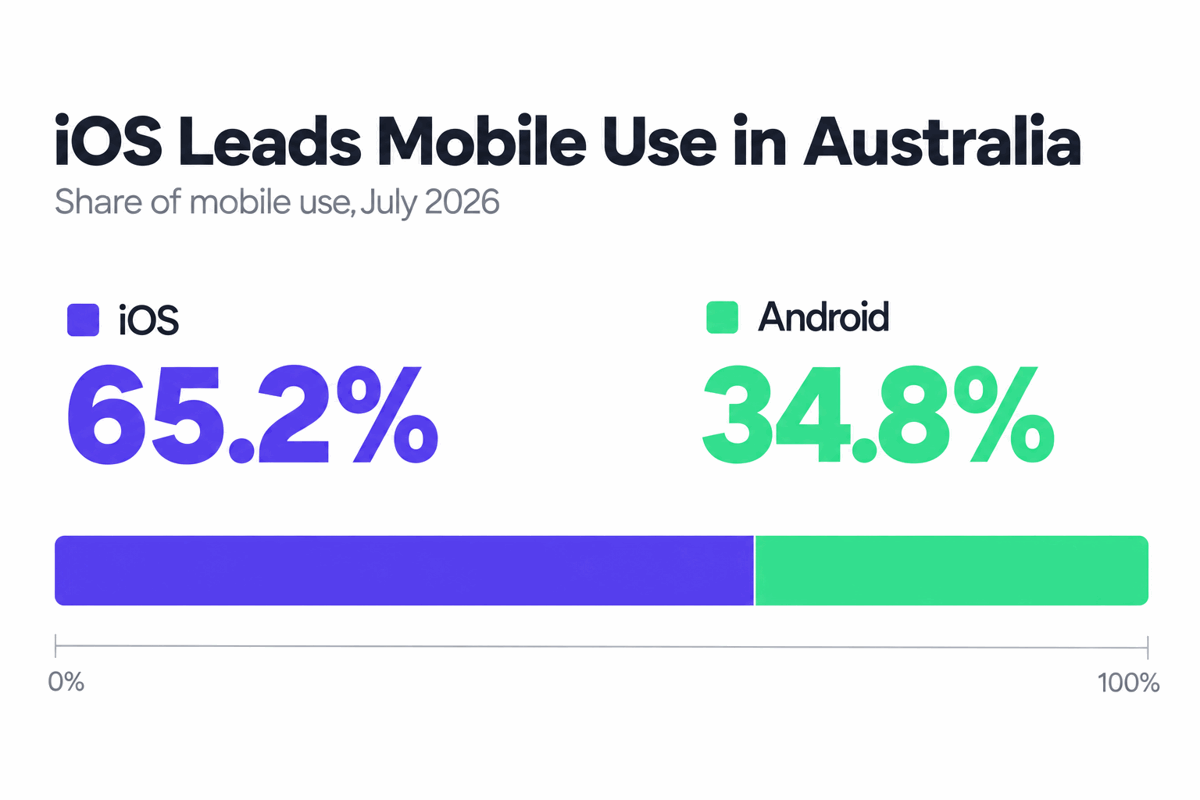
Based on over 3 billion monthly page views tracked by StatCounter across Australian IP addresses.
Source: StatCounter Global Stats · gs.statcounter.com/os-market-share/mobile/australia · Data reflects mobile web usage share, not device sales.
Should You Build iOS or Android First as an Australian Startup?
There isn't a universal answer, but there's almost always a right one for your specific product. Ask yourself these four questions before you write a line of code.
Where do your actual users live?
If they're concentrated in Sydney, Melbourne, or Brisbane, iOS reaches the majority. If they're regional, remote, or spread across a field-based workforce, Android's device flexibility and lower hardware cost matter more.
How are you making money?
iOS users spend meaningfully more per app worldwide, roughly double per year according to mobile analytics firm Adapty's 2025 data (US$140 versus US$69 annually). Australia's affluent, iOS majority market follows the same pattern. Subscriptions and in app purchases favour iOS. Ad-supported, volume-driven models favour Android's reach.
What does your app need to do on the device?
iOS development requires a Mac, since Xcode is macOS only, and Apple's tighter hardware range means fewer screen sizes and OS versions to test against. Android runs on any operating system and gives deeper access to hardware customisation: NFC, ruggedised devices, kiosk mode, and mass device management for a distributed workforce.
How regulated is your sector?
For finance, health, government, and enterprise tools where corporate device fleets skew iPad and iPhone, Apple's stricter App Store review tends to surface compliance issues before launch rather than after it. That's a genuine advantage, even though it can feel slower during submission.
Australia vs the World: Why the Global Rule Fails Here
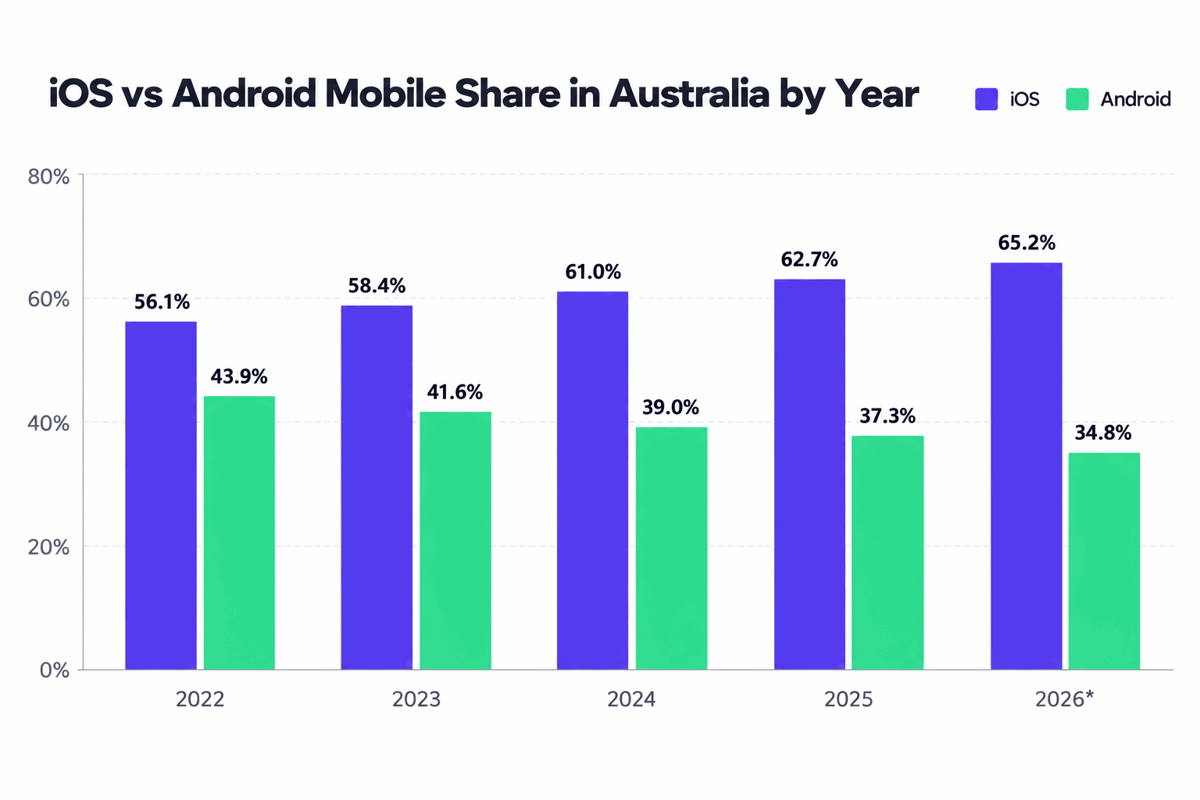
* 2026 figure reflects August 2026 data. Annual figures are full-year averages except 2026.
Source: StatCounter Global Stats — annual data · gs.statcounter.com/os-market-share/mobile/australia · Data reflects mobile web usage share, not device sales.
Who Actually Uses iOS vs Android in Australia, and Why It Matters for Your App
The platform split in Australia isn't just a market share number. It maps to real behavioural differences worth designing around.
iOS skews toward higher-income, professional, and urban users. They show stronger app store loyalty and higher subscription renewal rates.
Android's Australian base is broader across income levels and skews more regional. Users are typically more price-sensitive about both devices and in app purchases.
Neither group is more valuable in absolute terms. They respond to different monetisation models, which is exactly why matching your business model to the platform matters more than chasing the bigger number.
iOS First or Android First? Compare the Real Factors Side by Side
| iOS First | Android First | |
|---|---|---|
| Best audience fit | Metro, professional, higher income, premium consumer | Regional, blue collar, field service, price sensitive |
| Monetisation strength | Stronger for subscriptions and in app purchases | Stronger for volume and ad supported models |
| Development requirements | Requires a Mac and Xcode, narrower device matrix | Runs on any OS, far wider device and OEM fragmentation |
| Store fees | $149 AUD per year, Apple Developer Program | $38 AUD one off registration, Google Play Console |
| Review timeline | Typically 24 to 48 hours for standard submissions | Comparable for established accounts, slower for new accounts in sensitive categories |
| Testing burden | Lower, smaller device and OS matrix | Higher, meaningful QA effort across manufacturers and screen sizes |
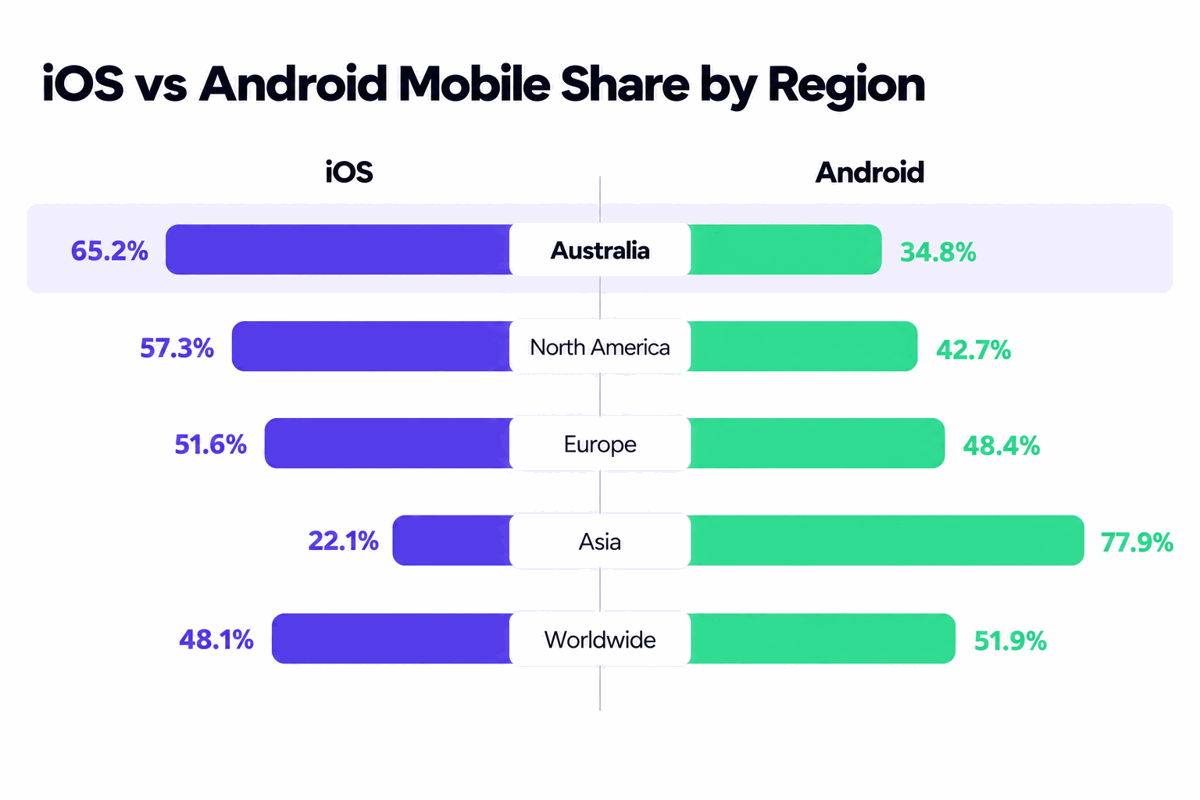
* 2026 figure reflects August 2026 data. Annual figures are full-year averages except 2026.
Source: StatCounter Global Stats — regional comparison · gs.statcounter.com/os-market-share/mobile · Data reflects mobile web usage share, not device sales.
Will Building for Android Cost You More in Testing and Support?
Often, yes. Worth budgeting for honestly rather than discovering it mid project.
Apple controls both hardware and OS, so an iOS build tests against a relatively small, predictable set of devices. Android runs across dozens of manufacturers with different screen sizes, chipsets, and OS versions still active. That means genuinely more QA hours to catch the same class of bugs.
This affects accessibility too. A screen reader issue on one Android OEM's implementation might not appear on another, so a build aimed at government, health, or education audiences needs a wider accessibility test pass than the equivalent iOS build.
Does Your Feature List Actually Change Which Platform You Should Build First?
Mostly, no, not the platform choice itself. It absolutely changes your budget, regardless of which platform you pick.
A simple app with a handful of screens and a standard backend costs roughly the same whether it's built for iOS or Android first. Add feature complexity and the cost climbs on both platforms at a similar rate:
- Custom animation and motion design
- Real time backend integrations with a CRM or payment gateway
- AI driven personalisation or recommendation logic
- Complex user roles and permission systems
Where the platform genuinely matters is design sophistication. iOS users expect stronger visual polish and platform native motion design, and Apple's own App Store review process scrutinises interface quality more closely than Google Play's does. If your product's edge is a highly designed, animation rich interface, that raises the bar on whichever platform you launch first, but it raises it slightly higher on iOS.
What Does It Actually Cost to Build iOS First vs Android First?
Close to the same, platform for platform. Here's how the tiers typically break down in Australia in 2026:
- Simple app or MVP: $15,000 to $50,000, largely independent of iOS or Android
- Mid complexity build with backend integrations and custom features: $50,000 to $150,000
- Complex or enterprise grade app: $150,000 upward
The real cost decision isn't which platform to build first. It's whether you build one platform natively, or use a cross platform framework to reach both for roughly the same spend as a single native build.
Building both platforms natively and separately, rather than picking one first, typically costs 1.7 to 1.9 times more than a single platform or cross platform build. That's exactly why "build first" is a genuine budget decision, not just a technicality.
Ongoing maintenance adds another 15 to 20% of your build cost per year, on either platform, covering OS updates, security patches, and bug fixes. Factor that into your first year budget regardless of which platform you launch on.
Is iOS or Android More AI Friendly for Your App in 2026?
Closer than you'd expect. Both are genuinely capable now, rather than one clearly leading.
Apple's on-device Foundation Models, available to developers through Swift since iOS 26, run AI features locally at no per-call cost and keep working offline. That matters for summarisation, autocomplete, or classification features, where cloud latency would otherwise hurt the experience.
Android's equivalent is Gemini Nano, delivered through Google's AICore runtime. It also runs on-device, with no API key and no cloud round trip.
The practical difference sits in the developer ecosystem, not raw capability. Apple's approach is Swift native and tightly scoped to Apple silicon. Google's is Kotlin native and spread across a wider range of Android chipsets, with less consistent performance device to device.
If AI features are core to your product and you're launching on a single platform first, both now offer a genuine free, on-device option. This factor shouldn't tip your platform decision on its own the way it might have a year or two ago.
Do I Really Have to Choose? The Cross-Platform Alternative
Increasingly, no. If your audience genuinely spans both platforms, which describes most mainstream Australian consumer apps, a cross platform framework reaches both from a single codebase instead of picking a launch order and hoping the second platform can wait.
Our full breakdown of that trade off is in the Flutter vs React Native comparison, worth reading before committing to a single platform build.
Native still earns its place for deep, platform specific hardware needs, or when extending a large existing codebase in either iOS app development or Android app development.
iOS vs Android First FAQs
For most consumer apps, iOS first is the safer default in Australia, since iOS holds around 65.2% of local mobile use as of July 2026 and iOS users typically spend more per app. Android first suits regional, blue collar, or ad supported apps where reach and device flexibility matter more than per user revenue.
As of July 2026, StatCounter puts iOS at around 65.2% of Australian mobile use and Android at around 34.8%. This is the reverse of the global picture, where Android holds roughly 70%, so global statistics shouldn't guide an Australian platform decision.
Building for either single platform costs roughly the same in raw development terms. Android typically adds more QA time due to device fragmentation across manufacturers, while iOS benefits from a narrower, more predictable device matrix.
Usually not natively. Two separate native apps roughly double cost and ongoing maintenance. Most Australian startups either launch on one platform first and expand once validated, or use a cross platform framework like Flutter or React Native to reach both from a single codebase.
Not much anymore. Both stores typically review standard submissions within a day or two in 2026. Audience and monetisation should drive the platform decision, not review speed.
Both now offer genuine free, on-device AI. Apple's Foundation Models run locally through Swift, and Android's Gemini Nano runs locally through AICore. Neither requires a per-call API cost, so AI friendliness alone shouldn't decide your platform choice in 2026.
Plan for roughly 15 to 20% of your original build cost per year, on either platform, covering OS updates, security patches, and bug fixes. This applies whether you launch iOS first, Android first, or build cross platform.
Still Deciding Between iOS, Android, or Both?
The right starting platform depends on your specific audience and business model, not a generic rule. Talk to us about your app and we'll give you a clear recommendation, including whether a cross platform build makes more sense than picking one platform at all.