
The R&D Tax Incentive is the main way Australian startups offset app development costs, refunding 43.5% to 48.5% of eligible R&D spend for companies with under $20 million in turnover.
Government grants exist too, but most are sector-specific, competitive, and far narrower in scope than the tax incentive, which is an open entitlement program available to any eligible company that applies.
If your app development involves genuine technical uncertainty, not just a standard build using existing frameworks, the R&D Tax Incentive can put a meaningful chunk of your development spend back in the bank as cash. This guide covers the current 2026 rates, what actually qualifies, how to claim it step by step, and where it fits against the grants available to Australian app startups.
This article is general information, not tax or financial advice. Confirm your eligibility and claim with a registered tax agent or R&D consultant, and refer to business.gov.au for the current program rules.
What Is the R&D Tax Incentive for App Development?
The Research and Development (R&D) Tax Incentive is jointly administered by AusIndustry (part of the Department of Industry, Science and Resources) and the Australian Taxation Office. It reduces the cost of eligible R&D through a tax offset, and for most startups, that offset is refundable, meaning you get it back as cash even if your company is still in a tax loss position.
The current 2026 rates:
- Refundable offset, 43.5%, for companies with turnover under $20 million taxed at the 25% base company tax rate (25% plus an 18.5% premium)
- Refundable offset, 48.5%, for companies with turnover under $20 million taxed at the standard 30% company tax rate (30% plus an 18.5% premium)
- Non-refundable offset, 33.5% to 42%, for companies with turnover of $20 million or more, calculated as the company tax rate plus a two-tier premium based on R&D intensity
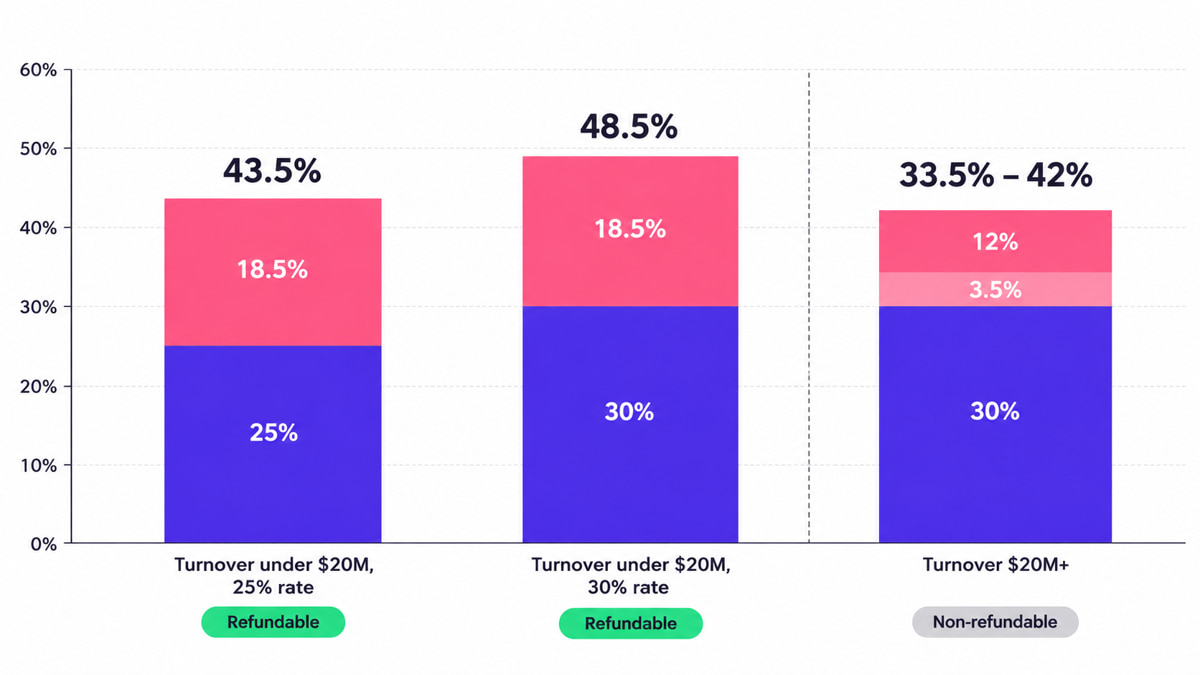
Most early-stage app startups sit in the 43.5% bracket. Spend $200,000 building genuinely novel software and qualify in full, and that's up to $87,000 back as cash, before you've made a dollar of revenue. The program is mainstream rather than niche: the ATO's most recent transparency report shows 12,956 companies claimed the incentive in a single year, reporting a combined $16.2 billion in R&D expenditure.
A change is coming, but not yet. The Australian Government announced reforms to the R&D Tax Incentive in the 2026 to 27 Budget, including a higher offset rate and a lifted turnover threshold. The ATO has confirmed these changes start from 1 July 2028, and the program continues to run under the current rules until then. The rates above are what apply right now.
Is Your App Development Eligible?
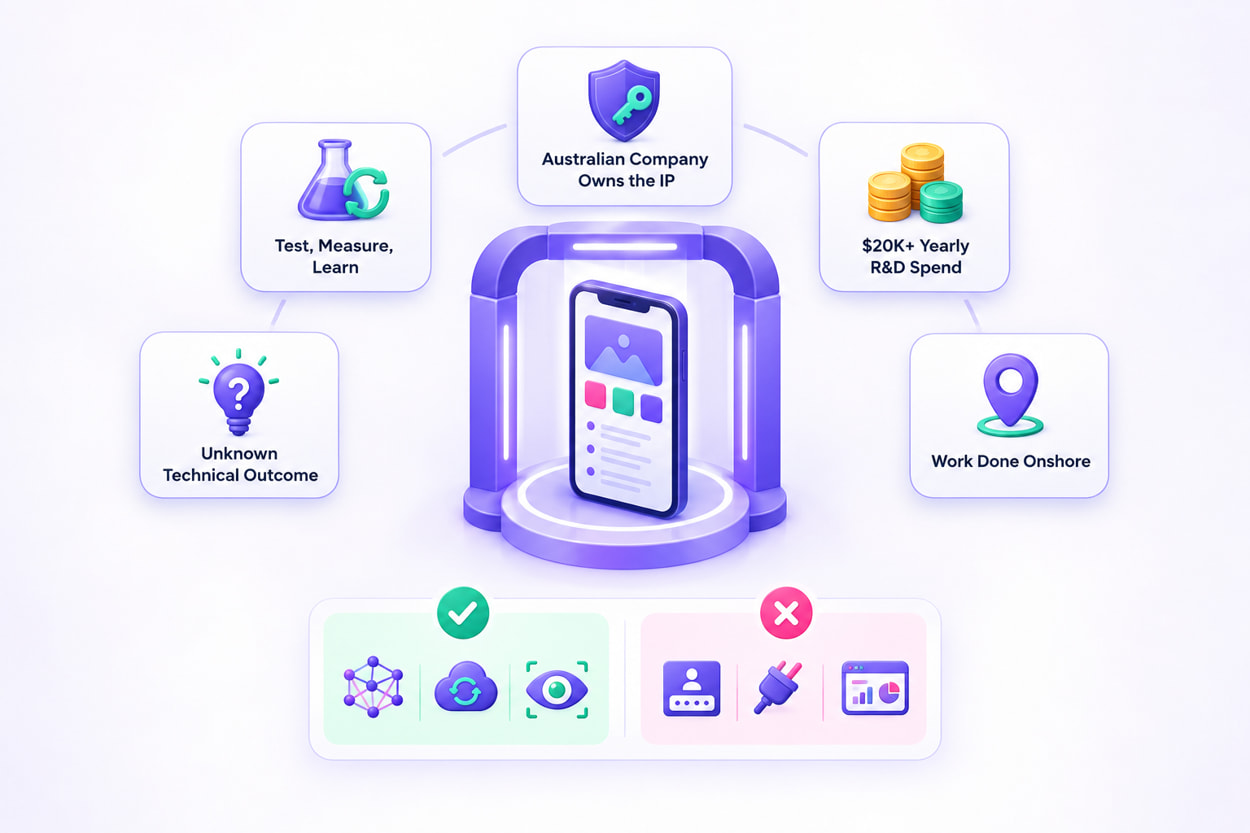
This is where most founders get it wrong. The R&D Tax Incentive isn't a general startup subsidy; it's for work that resolves genuine technical uncertainty through systematic experimentation. To qualify, your project broadly needs to:
- Attempt to resolve a technical problem a competent professional couldn't solve using existing, publicly available knowledge, where the outcome can't be known in advance
- Follow a systematic progression: hypothesis, experiment, evaluation, conclusion, not just build and ship
- Be conducted by a registered Australian company (an R&D entity) that bears the financial risk, controls the direction of the work, and owns the resulting IP
- Meet a minimum spend of $20,000 in eligible R&D expenditure per year (claims below this must go through a Research Service Provider)
Eligible activities fall into two categories: core R&D activities (the genuinely experimental work itself) and supporting R&D activities (directly related work like test environment setup or data preparation that exists because the core experiment exists). Routine QA, standard maintenance, and general product management usually sit outside both categories.
A failed experiment doesn't disqualify a claim. If the work involved real technical uncertainty and a systematic attempt to resolve it, the outcome not going to plan doesn't change its eligibility, and the ATO treats it accordingly.
"We built a credit risk scoring model for a fintech client that drew on transaction behavioural data rather than traditional bureau signals. The model architecture was genuinely experimental. We were working with a proprietary dataset that had never been used for this purpose, and the question of whether behavioural patterns in that data could produce reliable risk signals wasn't answerable in advance. That's the kind of project where the R&D case almost writes itself if you've kept the right records. What I tell founders now is that if your technical lead can't explain in plain English what question the experiment was trying to answer and why the answer wasn't known beforehand, the claim is going to be harder to defend than it needs to be."
Vrushank Shah, Appmart
Examples that typically qualify:
- Building a novel machine learning model trained on your own proprietary dataset
- Developing an unproven architecture for real-time data sync across offline-first mobile devices
- Original computer vision or natural language processing work where the result isn't known in advance
- Engineering a new method to scale a system beyond what standard cloud architecture patterns support
Examples that typically don't qualify:
- Wiring up a CRM or payment gateway using a documented, publicly available API
- Building standard CRUD screens, login flows, or admin dashboards with established frameworks
- Calling an existing AI model such as an LLM API without any novel engineering built around it
- UI/UX design, market research, or testing that doesn't involve technical experimentation
One overlooked catch: where the work happens. Eligible R&D generally has to be conducted in Australia. Work performed overseas can only be included if you obtain an Overseas Finding from the Department of Industry, Science and Resources before the end of the relevant income year, and that requires proving Australia genuinely lacks the expertise or facilities involved, not simply that it's cheaper offshore. If part of your build runs through an offshore team, flag this early with your advisor rather than assuming it will be swept into the claim.
"The claims that hold up under review are the ones where the technical story and the cost records agree from day one. Founders who wait until tax time to reconstruct what was actually uncertain about the build almost always leave money on the table, or worse, have a claim challenged."
Vrushank Shah, Appmart, on preparing R&D documentation alongside a build
How Do You Claim the R&D Tax Incentive?
R&D Tax Incentive eligibility is fact-specific and depends on the technical nature of your project, your company structure, and your expenditure records.
This article is general information only. Before registering a claim, confirm your eligibility and approach with a registered tax agent or R&D consultant who can assess your specific circumstances. Appmart can help clients scope and document projects appropriately from day one.
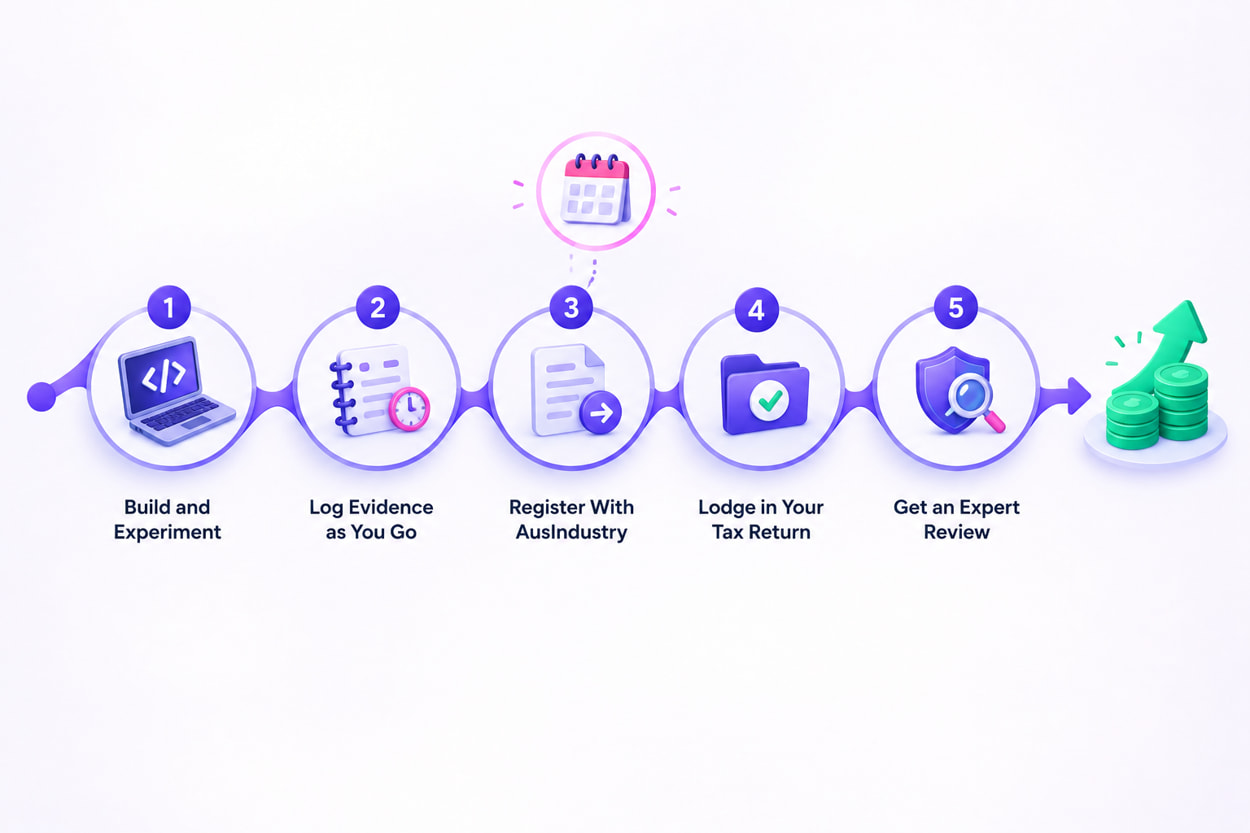
- Do the eligible work first. You register and claim activity that has actually happened, not a plan for future work.
- Register with AusIndustry. Submit your R&D activities through the customer portal within 10 months of the end of your company's income year. For a standard 30 June year-end, that's a 30 April deadline the following year, strictly enforced.
- Keep contemporaneous records. Document the technical uncertainty, the experiments run, and the outcomes as you go. Retrospective paperwork is the most common reason claims get challenged.
- Claim the offset in your company tax return. Once registered, you claim the offset when you lodge your company tax return with the ATO, using your notional R&D deductions multiplied by your offset rate.
- Expect scrutiny on borderline claims. AusIndustry and the ATO jointly review claims, and software claims attract particular attention because the line between engineering and R&D is often unclear. A registered tax agent or R&D consultant experienced with software claims earns their fee here.
"We were a Melbourne logistics startup and honestly hadn't thought about the R&D incentive until Appmart flagged it during scoping. The offline sync problem we were asking them to solve turned out to be exactly the kind of work that qualifies. It wasn't a standard build, and there was a real question of whether the architecture would hold up under the conditions we needed. We claimed in our first full financial year of trading, and it materially changed our runway. The documentation Appmart had kept from the build was most of what our R&D consultant needed."
Founder, Melbourne logistics technology startup (name withheld at client request)
R&D Tax Incentive vs Government Grants: What's the Difference?
| R&D Tax Incentive | Government Grants | |
|---|---|---|
| What it is | An entitlement; if you're eligible, you get it | A competitive, limited pool of funding |
| Application process | Register after doing the work, no competition | Apply before or during the work, assessed against other applicants |
| Typical value | 43.5% to 48.5% of eligible R&D spend, no upper cap for most startups | Fixed amounts, often $20,000 to $5 million depending on the program |
| Availability | Ongoing, every income year | Specific rounds, often closed for months |
| Sector restrictions | None, any industry, including standard app builds | Often restricted to specific sectors or states |
| Co-contribution required | No | Usually yes, commonly 25 to 50% of project cost |
What Grants Are Actually Available for App Development in Australia?
Genuine app-specific grants are rarer than marketing pages suggest. MVP Ventures (NSW only, via Investment NSW) funds $20,000 to $75,000 for NSW-headquartered startups commercialising an innovative product, competitively assessed with a required co-contribution. The federal Industry Growth Program offered $50,000 to $5 million in matched grants. Still, as of the 2026 Budget, it's paused to new applications while under redesign, and was restricted to National Reconstruction Fund sectors that exclude most standard apps anyway. Victoria's LaunchVic and Breakthrough Victoria are being merged into a new body through 2026, worth watching directly rather than assuming today's programs still exist by the time you apply.

The honest takeaway: grants for app development specifically are thin, geographically restricted, and often sector-locked. The R&D Tax Incentive applies Australia-wide, to any eligible company, every income year. If you're building genuinely novel software, check it first.
App Development Grants & R&D Tax Incentive FAQs
Yes, if the work involves genuine technical uncertainty resolved through systematic experimentation, such as a novel algorithm or original machine learning work. Standard builds using established frameworks and documented APIs generally don't qualify.
Companies under $20 million turnover can claim a refundable offset of 43.5% (base tax rate) or 48.5% (standard tax rate). Companies with $20 million turnover or more receive a non-refundable offset of 33.5% to 42%.
Yes. Eligibility turns on whether the work involved genuine technical uncertainty and a systematic attempt to resolve it, not whether the project succeeded commercially.
Generally no, unless you obtain an Overseas Finding before year-end proving Australia lacks the relevant expertise or facilities. Cost alone doesn't satisfy this test, so isolate offshore work early rather than folding it into the claim.
Very few. NSW's MVP Ventures ($20,000 to $75,000) is the closest fit but is restricted to NSW businesses. The federal Industry Growth Program is paused as of 2026 and limited to sectors that exclude most standard apps.
Talk to Someone Who Understands Both the Build and the Claim
Getting the R&D Tax Incentive right starts with how a project is scoped and documented from day one. And not as an afterthought once development is finished. As a Melbourne app development team that has worked across genuinely novel AI, machine learning, and integration builds, Appmart can help you scope a project with the technical documentation an R&D claim actually needs.
R&D eligibility is fact-specific. Confirm your position with a registered tax agent before lodging.