
Building a compliant digital health platform in Australia requires far more than integrating a basic video calling interface. Success demands a secure engineering architecture that works directly with the Medicare Benefits Schedule, the Australian Digital Health Agency, and the strict obligations of the Privacy Act 1988.
Telehealth app development focuses on designing and operating software capable of handling live video consultations, asynchronous care, electronic prescribing, and remote patient monitoring. For founders, chief technology officers, and product leaders, the challenge lies in balancing advanced clinical workflows with uncompromising sovereign data security.
Here is the technical and regulatory blueprint for building production-grade telemedicine software tailored to the Australian healthcare ecosystem.
Navigating MBS Rules and Medicare Billing Integration

MBS billing rules dictate exactly how medical software must record and process remote encounters. The government requires the practitioner, or their practice, to have provided a face-to-face service to the patient within the previous twelve months to claim most telehealth item numbers. Patients registered in MyMedicare with that practice are exempt, along with groups such as infants under 12 months and people experiencing homelessness.
A successful telemedicine app development project must include a robust billing rules engine capable of handling these complex conditions.
- Eligibility Verification: Platforms must automatically verify patient eligibility before the consultation begins.
- Time Tracking Automation: The system must capture the exact duration of video or telephone attendances, matching them securely against current MBS item numbers.
- Audit Readiness: Storing the source transmission dates and eligible staff activity lets clinic administrators map every claim to permitted code combinations, preventing claim rejections and reducing administrative overhead.
Appmart engineers platforms with native Medicare billing integration. Appmart aligns billing architectures around specific telehealth reimbursement requirements so claiming happens correctly the first time.
Electronic Prescribing and ADHA Conformance
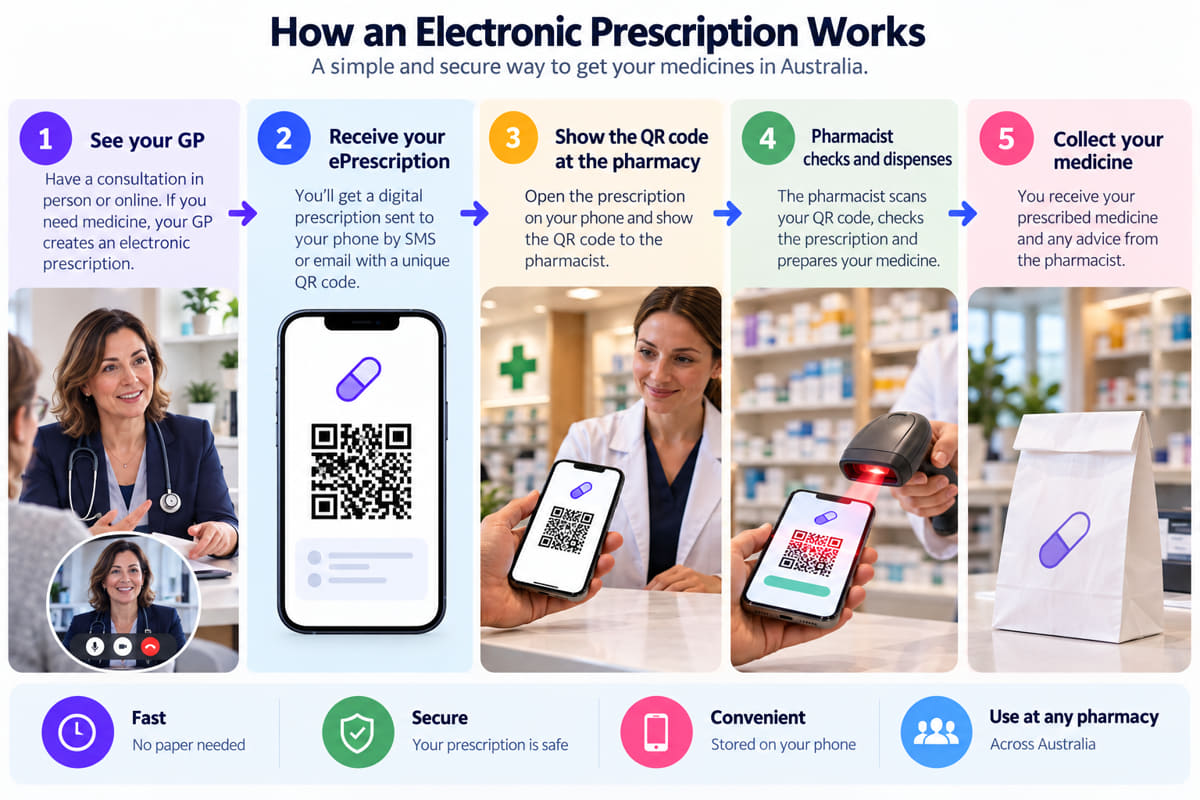
Electronic prescribing is now a permanent and critical fixture in Australian healthcare. Software must support both the token model and the Active Script List to provide patients with full control over their medication dispensing.
Telehealth platform development must incorporate rigorous technical conformance testing with the National Prescription Delivery Service.
When you hire telehealth app developers, you must verify their capability to handle the Healthcare Identifiers Service. Appmart's engineering teams integrate Individual Healthcare Identifiers directly into the prescriber workflow. Appmart uses SNOMED CT-AU terminology so digital prescriptions and pathology requests are recognised by pharmacies and laboratories nationwide. The prescription is securely handed off for pharmacy fulfilment, eliminating ambiguity regarding where and when a script was dispensed.
Australian Privacy Principles and Sovereign Security
Compliance with the Australian Privacy Principles is an absolute legal mandate. Patient health information calls for dedicated sovereign infrastructure. Compliant platforms keep health data within Australian AWS or Azure regions to protect sensitive personal records.
Comprehensive telehealth app development services must prioritise security engineering from the first sprint.
- Data Encryption: Appmart implements TLS encryption for all data in transit. Databases, object storage, and backups are secured using AES encryption at rest.
- Access Control: Role-based access control stops administrative staff from accessing clinical notes or video recordings. Step-up authentication is required for sensitive actions like finalising an electronic prescription.
- Audit Logging: Searchable audit logs track exactly who accessed which patient record and from where, so compliance staff can review data flows instantly.
Core Interoperability and Clinical Architecture
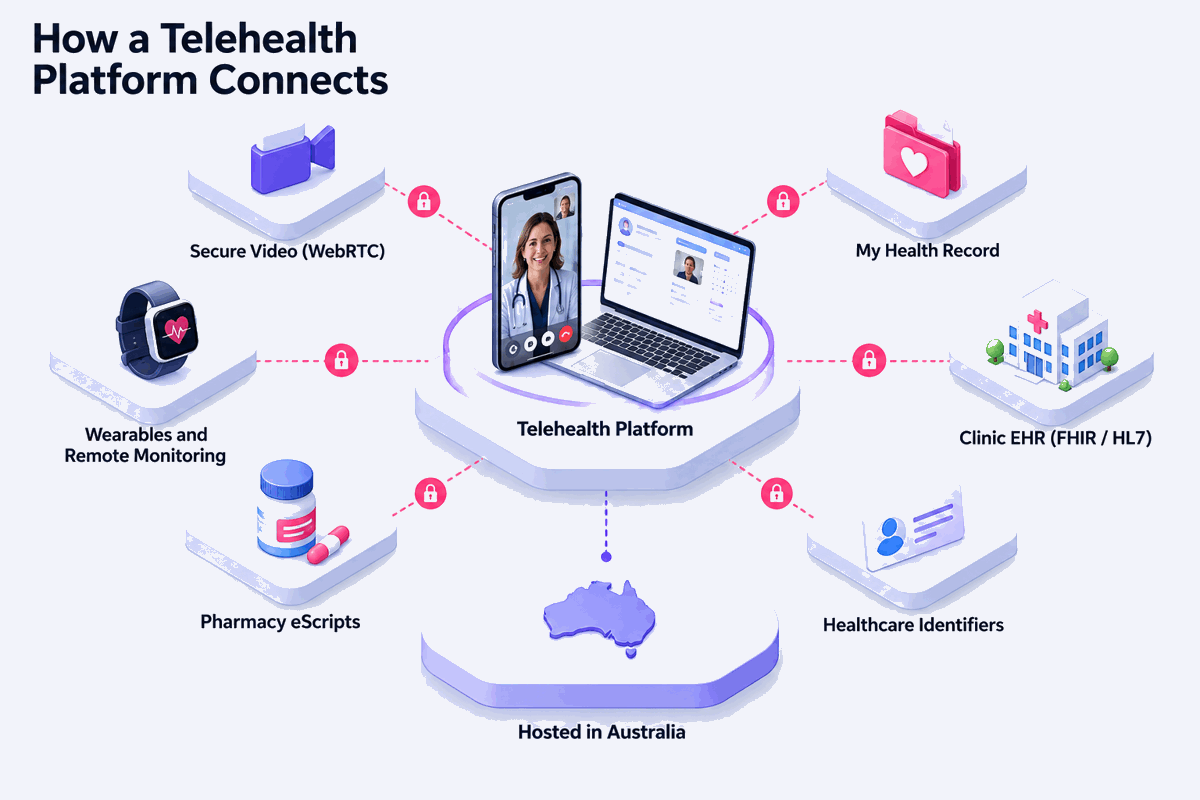
A standalone video tool creates disconnected workflows requiring clinicians to manually duplicate data entry. True interoperability connects your software directly to legacy electronic health records.
- WebRTC Video Capabilities: Appmart builds secure video consultation platforms using WebRTC standards. Engineering teams must deploy TURN relays to prevent peer connection failures when patients connect via strict corporate networks or hospital guest wifi.
- My Health Record Integration: The architecture must push consultation notes and read shared health summaries without requiring clinicians to leave their primary workspace.
- FHIR and HL7 Bridges: Appmart engineers secure data pipelines syncing appointments, consultation notes, and patient files across existing clinic systems.
- Asynchronous Care Protocol: When patients submit photos for dermatological review, the platform automatically strips location data from images before secure upload, protecting patient privacy.
The Telehealth App Development Lifecycle
Software follows the care model. Defining approved clinical workflows upfront saves months of engineering rework. A rigorous six-step delivery lifecycle protects both compliance and performance.
- Discovery and Clinical Workflow Mapping
Engineering teams map the exact consultation and prescribing workflow to identify what requires manual data entry between disconnected tools. - UI and UX Design
Product designers build accessible interfaces for both the clinician and patient side of every interaction. - Core Build and Integrations
The development phase connects My Health Record, the Healthcare Identifiers Service, and Medicare billing systems alongside the secure video layer. - Compliance Conformance Testing
Platforms must navigate the Australian Digital Health Agency technical conformance testing to verify every digital script and pathology request processes correctly. - Security Auditing
Security experts conduct strict dependency scanning, external penetration tests, and WCAG accessibility audits before real patient data enters the system. - Pilot and Launch
Clinical leads test the full patient journey from booking through to consultation and follow-up with a limited user group before the complete software rollout.
Advancing Care with AI-Powered Mobile App Development
Modern clinics require machine learning integration to scale operations and improve diagnostic accuracy. Advanced generative AI and predictive analytics are transforming how remote care is delivered.
Appmart deploys Core ML and TensorFlow Lite (now LiteRT) for on-device ML inference. This architecture keeps sensitive patient data inside the mobile application during initial triage, protecting privacy while delivering instant insights.
Furthermore, integrating ambient AI scribes allows the application to listen to consultations and draft clinical notes automatically. Clinical owners review these drafts before signing, maintaining strict professional standards while drastically reducing documentation time. For chronic care management, integrating wearables allows remote patient monitoring to track blood pressure and glucose levels continuously.
Telehealth App Development Cost and Investment Drivers
A single number for telemedicine app development cost is misleading because two apps with identical screens can differ drastically in budget depending on backend compliance and interoperability depth.
Custom telehealth builds in Australia typically start from AUD 70,000. True value sits in proper integration with national health infrastructure rather than just a polished video call interface.
| Project Scope | Technical Requirements | Estimated Cost Range |
|---|---|---|
| Minimum Viable Product | Custom patient app, clinician workspace, secure WebRTC video, basic booked slots | AUD 70,000 to AUD 90,000 |
| Mid Level Platform | MBS billing integration, certified electronic prescribing vendor, complete patient portal | AUD 90,000 to AUD 150,000 |
| Enterprise Ecosystem | My Health Record sync, HL7 and FHIR bridges, IoT remote patient monitoring ingestion | AUD 150,000 to AUD 350,000 |
Your Australian Technology Partner
Speak with Appmart's healthcare app team in South Melbourne.
Appmart builds compliant telehealth and healthcare applications for Australian clinical operators. Appmart takes complete ownership of your project, from custom user interface design to complex enterprise system integration.
Whether you need cross-platform mobile development or custom cloud-based AI architectures, Appmart engineers every solution for scalability, privacy, and measurable clinical outcomes.
Discuss Your Telehealth ProjectTelehealth App Development FAQs
Custom telehealth builds in Australia typically start from $70,000 for an MVP and range to $350,000 or more for enterprise platforms with full My Health Record integration and HL7/FHIR interoperability. Cost is driven primarily by compliance depth, not interface complexity.
Australian telehealth platforms must comply with the Privacy Act 1988 and the Australian Privacy Principles, MBS billing item rules, the Healthcare Identifiers Service requirements, and ADHA technical conformance testing for electronic prescribing. Platforms handling My Health Record data have additional obligations under the My Health Records Act 2012.
The Australian Digital Health Agency requires software that generates electronic prescriptions or pathology requests to pass technical conformance testing before going live. This confirms that digital scripts and requests are correctly formatted and will be recognised by pharmacies and laboratories nationally.
Yes. Integration with legacy electronic health record systems is achievable through HL7 and FHIR standards, which allow appointment data, consultation notes, and patient records to sync across platforms without requiring clinicians to duplicate data entry.
Sovereign infrastructure is the standard adopted by compliant Australian telehealth platforms. While the Privacy Act 1988 does not mandate a specific hosting jurisdiction, cross-border data disclosure triggers strict obligations. Australian AWS or Azure regions are the expected baseline for any platform handling patient health information.
An MVP telehealth platform with secure video, basic billing integration, and electronic prescribing typically takes 16 to 24 weeks from discovery to launch. Enterprise platforms with My Health Record sync and IoT integration take 9 to 18 months.