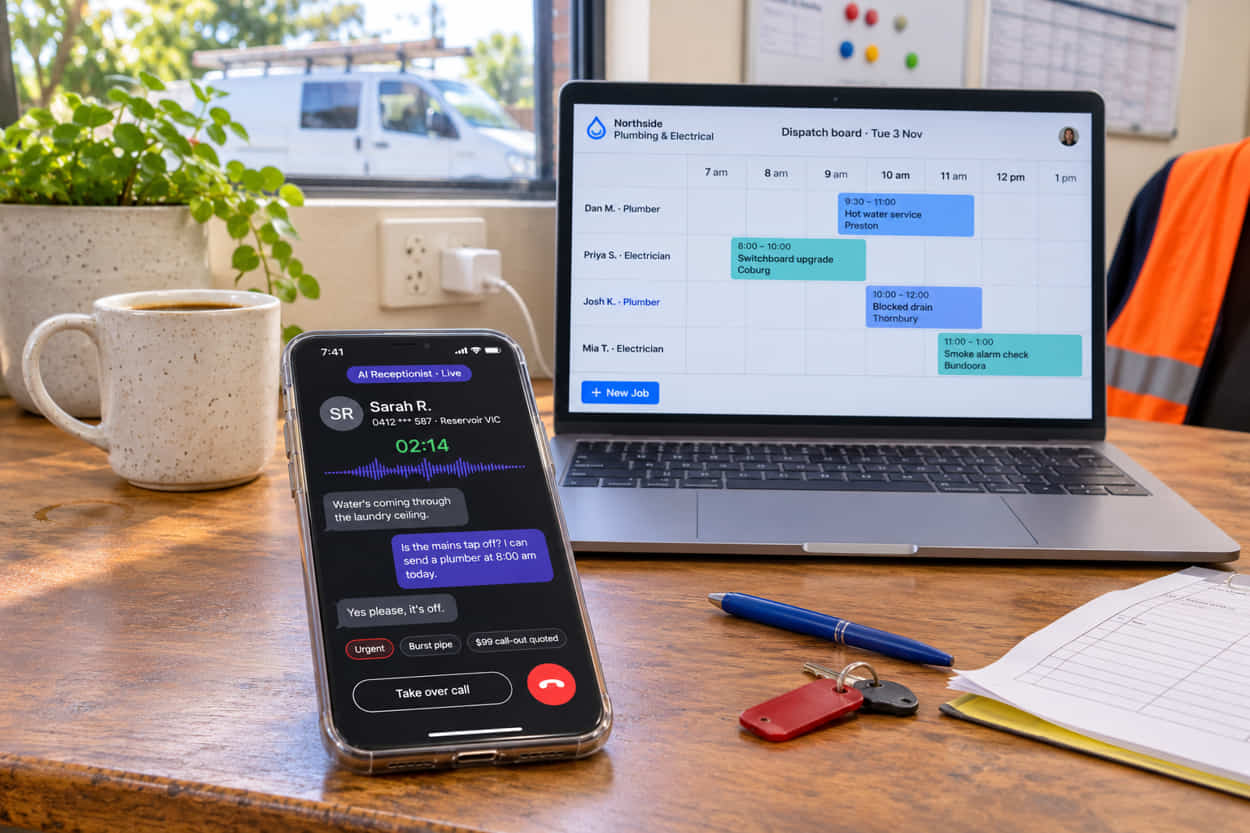
Custom telehealth software costs about $30,000 to $350,000 or more to build in Australia, depending on scope. A narrow video and booking build sits at the low end. A multi-clinic platform with Medicare claiming, electronic prescribing and My Health Record connectivity sits at the top.
Subscription tools cost far less to start, running from free for eligible practices to around $40 to $120 per clinician a month. Three factors drive the cost of a custom build: the features you need, the systems it must connect to, and the compliance work those connections bring.
Running costs matter too, because hosting, video usage and maintenance continue long after launch. Praharsh Parikh, Founder and CEO of Appmart, sets out indicative AUD ranges for each build level below. All estimates exclude GST, and every subscription price was checked on 23 November 2026.
What Is Telehealth Software and How Does It Work?
Telehealth software, sometimes called telemedicine software, lets clinicians consult patients by video or phone and manage everything around that consult. It handles booking, reminders, the virtual waiting room, the consult itself and the follow-up.
A typical virtual consultation follows a simple path. The patient books and receives an SMS or email link, then joins a virtual waiting room to complete consent or intake forms. The clinician admits them, runs the consult and writes notes, and the system handles payment, scripts or referrals.
Most clinics already run part of this workflow in practice management software. Telehealth software either sits beside that system or replaces parts of it, so integration scope drives much of the cost.
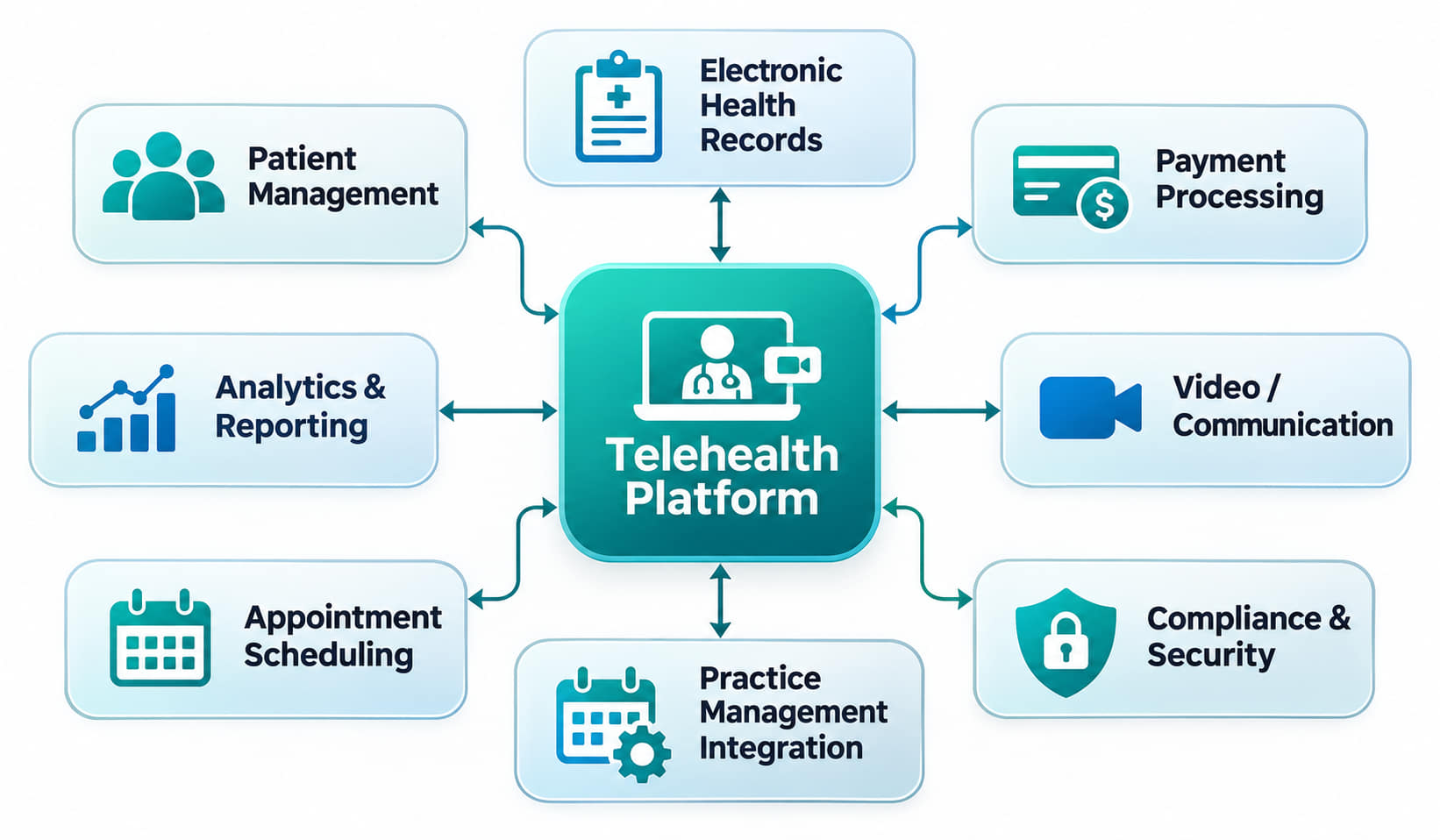
Key Components of Telehealth Software
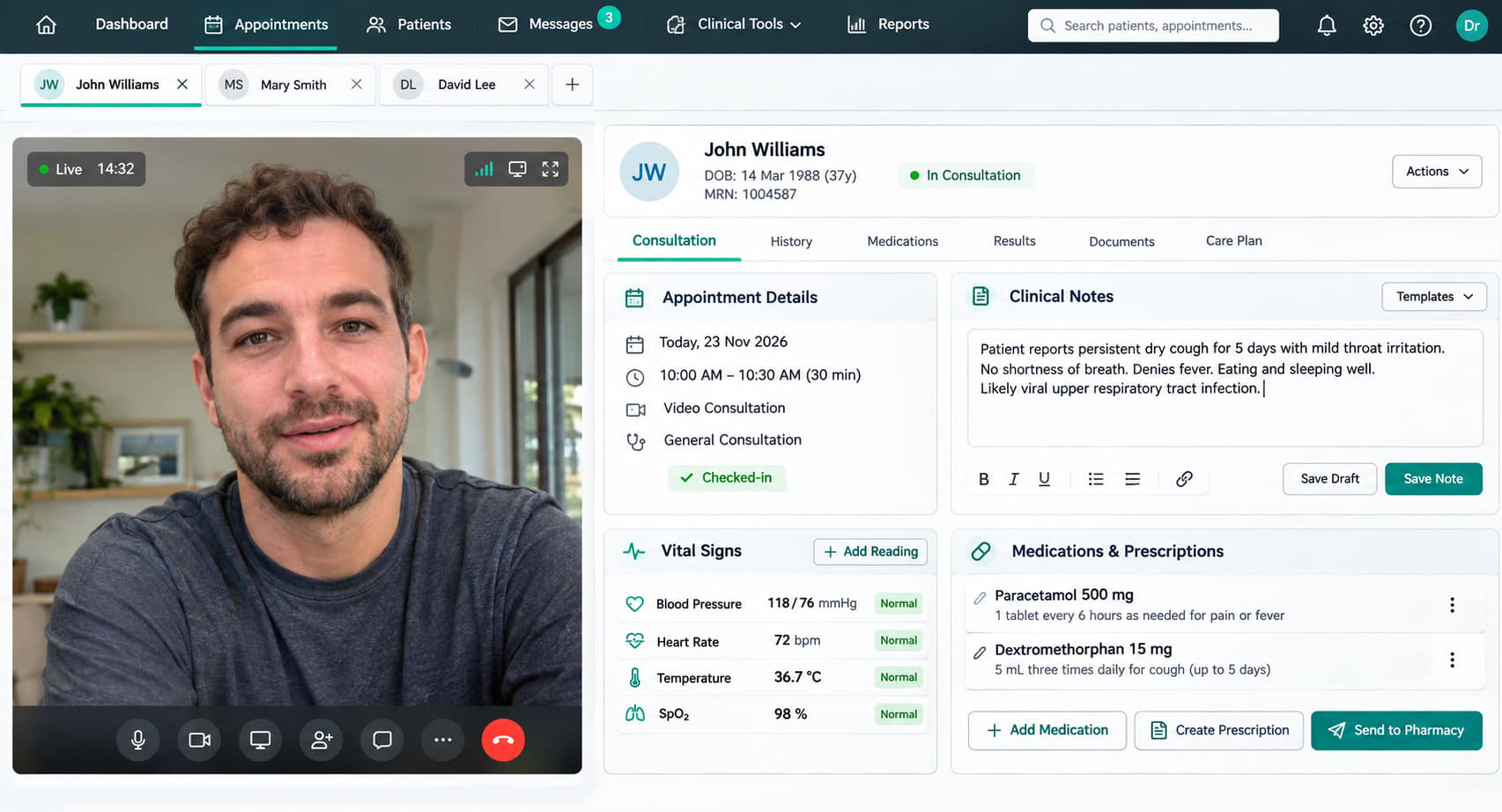
- Patient interface. A web or mobile app where patients register, book and join consults.
- Clinician dashboard. A workspace showing appointments, waiting patients, notes and tasks.
- Appointment scheduling. Calendars, availability rules, reminders and rescheduling.
- Video consultations. Encrypted audio and video, usually built on a third-party video service.
- Electronic prescriptions. Prescribing through software that meets Australian Digital Health Agency (ADHA) requirements.
- Patient records. Clinical notes, documents and history, held in the platform or a connected system.
- Payments. Card payments for private fees and, where relevant, Medicare claiming.
Who Needs Telehealth Software?

- General practices use telehealth for follow-ups, results and repeat scripts, within Medicare Benefits Schedule (MBS) rules.
- Specialist clinics use video for reviews and for regional patients who would otherwise travel.
- Allied health providers such as psychologists, dietitians and speech pathologists run full sessions online.
- Mental health practices deliver many sessions by video, so reliability and privacy matter most.
- Multi-location healthcare businesses need shared scheduling, central reporting and consistent workflows across sites.
Appmart builds each of these as custom telehealth solutions rather than forcing one workflow on every clinic type.
How Much Does Telehealth Software Cost in Australia?
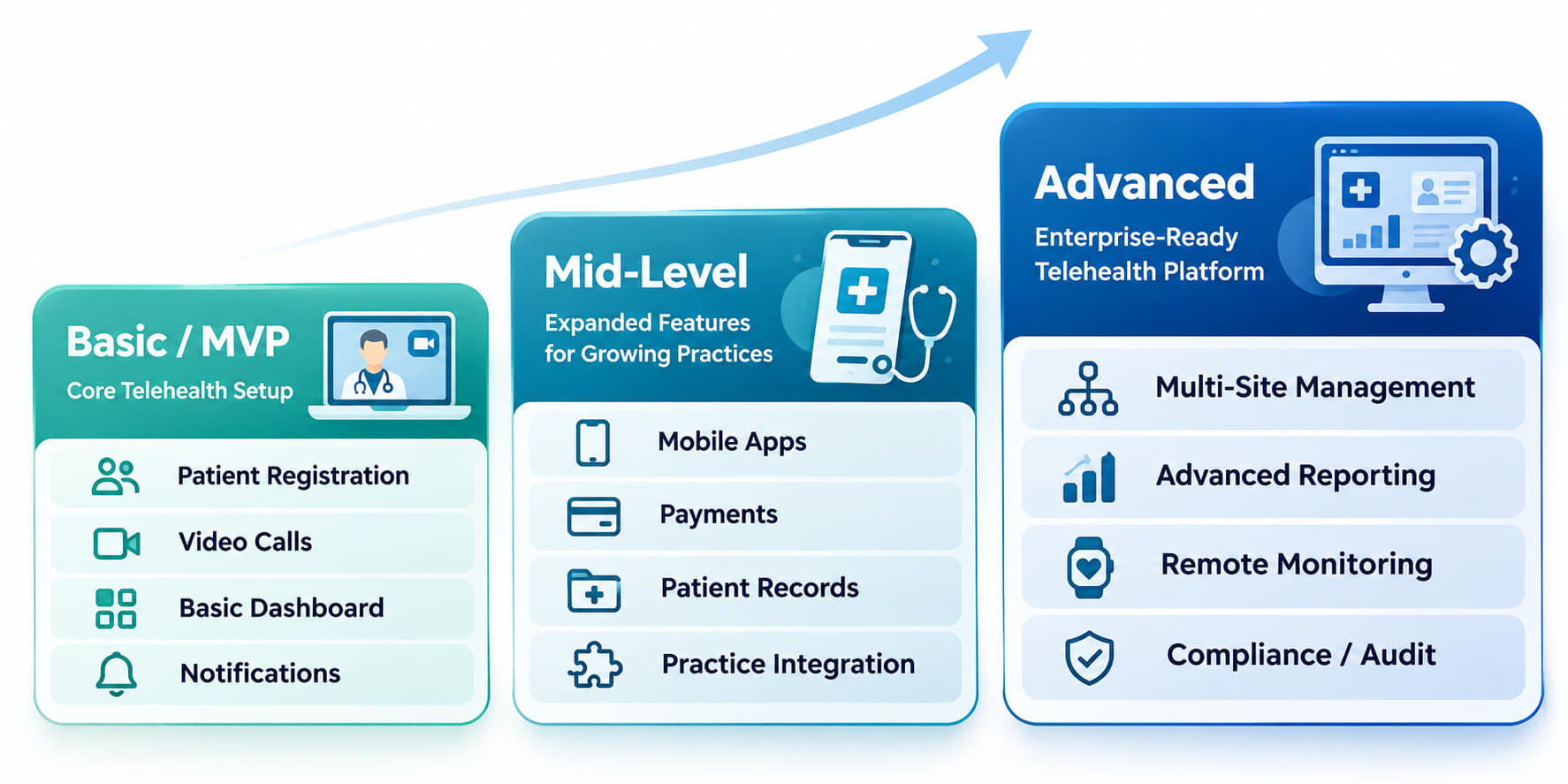
A custom telehealth platform costs about $30,000 to $350,000 or more to build in Australia. The cost to build telehealth software usually falls into one of three levels, shown below as indicative Appmart estimates.
| Development level | Indicative cost (AUD, ex GST) | Typical scope | Best suited to |
|---|---|---|---|
| Basic telehealth MVP | $30,000 to $70,000 | Web booking, secure video, simple dashboard, notifications | A single clinic or a startup testing demand |
| Mid-level platform | $70,000 to $150,000 | Patient and clinician apps, payments, records, practice software integration | Established practices and growing providers |
| Advanced platform | $150,000 to $350,000+ | Multi-clinic management, reporting, remote monitoring, FHIR, My Health Record | Multi-site groups, health networks and funded health tech |
These ranges are planning estimates, not quotes or market averages. Requirements, design depth, integrations, team rates and security needs all move the final figure. Appmart's app development cost guide puts senior Australian development at $150 to $250 an hour.
Basic Telehealth Software: AUD $30,000 to $70,000
A basic build covers the minimum a clinic needs to run virtual consults under its own brand. It includes patient registration, appointment scheduling, secure video, a basic clinician dashboard, and email and SMS notifications.
To stay in this range, the build runs as a responsive web app rather than native iOS and Android apps. It uses an existing video service and leaves out Medicare claiming, prescribing and practice software integrations. Staff may still bill and file notes in other systems, which suits a startup or a clinic with one simple service.
Mid-Level Telehealth Platform: AUD $70,000 to $150,000
A mid-level platform adds features that cut admin work. Expect patient and clinician mobile apps, advanced scheduling, payment processing and patient records. It also adds practice management integrations and, where required, electronic prescribing through a conformant prescribing partner.
Integrations explain most of the jump. Each connection needs data mapping, error handling and testing against the other system's sandbox.
Advanced Telehealth Software: AUD $150,000 to $350,000+
Advanced platforms serve several clinics, services or partner organisations at once. Typical features include multi-clinic management, advanced reporting, remote patient monitoring, HL7 or FHIR integrations and full audit logging. Some also need My Health Record connectivity and detailed access controls.
Conformance testing, data mapping and security depth push the cost up. Platforms that connect to national health systems must pass ADHA or Services Australia testing before going live.
What Is the Difference Between Subscription Telehealth Software and Custom Development?
Subscription telehealth software is a ready-made product you rent per clinician or per practice. Custom development builds a platform around your own workflows, which you pay for upfront and then maintain.
Subscription-Based Telehealth Software
Subscription tools work out of the box. Setup usually takes days, and the vendor handles hosting, security patches and updates. In return, you accept the vendor's workflows, branding limits and integration list.
Telehealth platform pricing in Australia (published prices, checked 23 November 2026)
| Product | Published price | Billing basis | What the plan covers | Notes |
|---|---|---|---|---|
| Healthdirect Video Call | Free for general practices, Aboriginal Medical Services and ACCHOs | Government-funded licence | Video calls, virtual waiting rooms, multi-party calls | Allied health, mental health and aged care are also eligible groups |
| Coviu | $40, $54 or $99 per clinician a month (annual); $48, $64 or $119 monthly | Per clinician | Unlimited video, waiting areas, Stripe payments; top plan adds AI scribe and phone | Prices exclude GST; AI Scribe add-on $79, phone add-on $25 |
| Halaxy | Free core platform | Free core, with fees on some payments and add-ons | Practice management with built-in video and phone telehealth | Check which features sit in paid add-ons |
| Cliniko | US$45 to US$395 a month (about $68 to $593) | Tiered by number of practitioners | Practice management that lists telehealth as a feature | Billed in USD; SMS costs 10 US cents each |
Telehealth software subscription cost grows with your team. Payment processing fees, SMS charges, AI scribe add-ons and per-clinician pricing all add up.
Custom-Built Telehealth Software
A custom build fits the software to your clinic rather than the reverse. You decide the booking rules, intake forms, triage steps, branding and connected systems.
Ownership depends on the contract, not the build. Check that the agreement assigns the source code and intellectual property to you, or grants a licence you accept.
Which Option Is Better for Your Clinic?
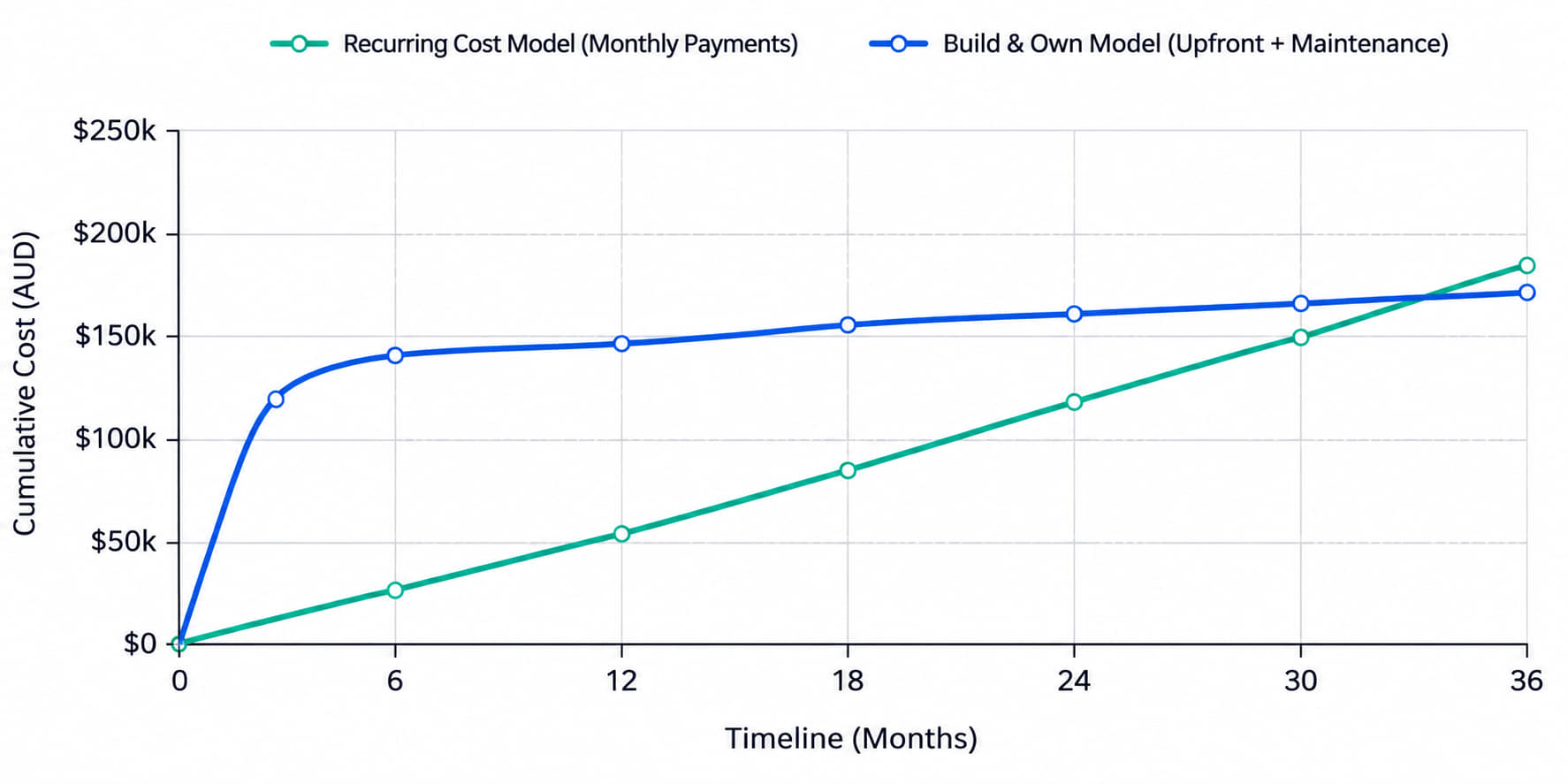
A three-year view makes the trade-off clearer. The figures below are illustrative estimates, not quotes.
| Three-year cost (ex GST) | 10 clinicians | 60 clinicians |
|---|---|---|
| Subscription: Coviu Clinic Bundle at $99 per clinician a month | $35,640 | $213,840 |
| Custom build (estimate) | $83,300 | $202,800 |
| Custom build assumptions | $50,000 build, 15% yearly maintenance, $300 a month for hosting and video | $120,000 build, 15% yearly maintenance, $800 a month for hosting and video |
Subscription makes sense for most single practices, and for clinics that want telehealth running this month. Custom development makes commercial sense when telehealth is the product itself, such as a virtual clinic startup. It also suits groups paying for dozens of seats, or providers whose workflows no ready-made tool supports.
| Option | Best for | Typical cost | Trade-off |
|---|---|---|---|
| Ready-made software | Single practices and fast starts | Free to about $120 per clinician a month | Vendor workflows and per-seat fees |
| Custom development | Multi-site groups, virtual clinics and unique workflows | From $30,000 to build, plus running costs | Upfront budget and ongoing maintenance |
The same build-or-buy maths applies to clinic phone and booking automation. Appmart's guide to AI receptionist costs in Australia works through the identical comparison for front-desk software.
What Features Affect Telehealth Software Development Costs?
Each feature adds design, build and testing time. The table shows indicative Appmart estimates for each feature when built as part of a larger project.
| Feature | Indicative cost (AUD) | Include in MVP? |
|---|---|---|
| Patient registration and user management | $5,000 to $12,000 | Yes |
| Video consultation and virtual waiting room | $8,000 to $20,000 | Yes |
| Scheduling and notifications | $6,000 to $15,000 | Yes |
| Electronic health records and patient portal | $15,000 to $40,000 | Later unless records are central |
| Card payments | $4,000 to $10,000 | Yes for private billing |
| Medicare claiming integration | $15,000 to $40,000 | Later |
| Electronic prescribing integration | $10,000 to $30,000 | Later unless prescribing is central |
| Remote patient monitoring | $25,000 to $80,000+ | Later |
What belongs in an MVP? Registration, scheduling, video, notifications and basic payments cover most first releases. Records, Medicare claiming, prescribing and remote patient monitoring can follow once usage shows where staff lose time.
How Much Does Each Telehealth Software Development Stage Cost?
Budget splits differ by project, but the pattern below is common for a $100,000 mid-level build. The percentages are illustrative examples, not fixed industry figures.
| Development stage | Example share of budget | Example cost on a $100,000 build |
|---|---|---|
| Scoping and requirements analysis | 7% | $7,000 |
| UI/UX design | 12% | $12,000 |
| Frontend and backend development | 45% | $45,000 |
| Third-party API integrations | 16% | $16,000 |
| Security and quality assurance testing | 15% | $15,000 |
| Release and launch | 5% | $5,000 |
Scoping and Requirements Analysis
Scoping maps your clinical workflows, user roles, integrations and compliance needs before design starts. It produces a scope document, a feature priority list and a fixed estimate.
Skipping this stage rarely saves money. A gap found mid-build, such as an unplanned Medicare rule, costs more to fix than to plan.
Frontend and Backend Development
Frontend work builds what users see in the web and mobile apps. Backend work builds the server, database, business rules and APIs behind them.
This stage takes the largest share because it carries every feature. Native apps add a large part of telehealth app development cost in Australia. Cross-platform frameworks such as Flutter or React Native can reduce the cost of supporting both iOS and Android.
Australian Compliance and Integration Costs to Consider
Compliance costs depend on what your platform does, not on the word telehealth. A video-only tool for a psychology practice carries far fewer obligations than a GP platform that prescribes and claims Medicare. This section is general information, not legal advice.
| Requirement | When it applies | Cost impact |
|---|---|---|
| Privacy Act 1988 and Australian Privacy Principles | Always, for health service providers | Baseline Built into design, security and policies |
| My Health Record | The platform views or uploads My Health Record documents | High Gateway integration and conformance testing |
| MBS billing | The platform claims, or supports claims for, Medicare rebates | Medium to high |
| Electronic prescribing | The platform issues prescriptions | High if built; moderate through a partner |
| Healthcare Identifiers Service | The platform looks up or validates healthcare identifiers | Medium Two rounds of testing |
| HL7 and FHIR | The platform exchanges data with other clinical systems | Varies With each connection |
What Are the Ongoing Costs of Running Telehealth Software?
Running costs continue for the life of the platform. Some scale with usage each month, while others arrive once a year.
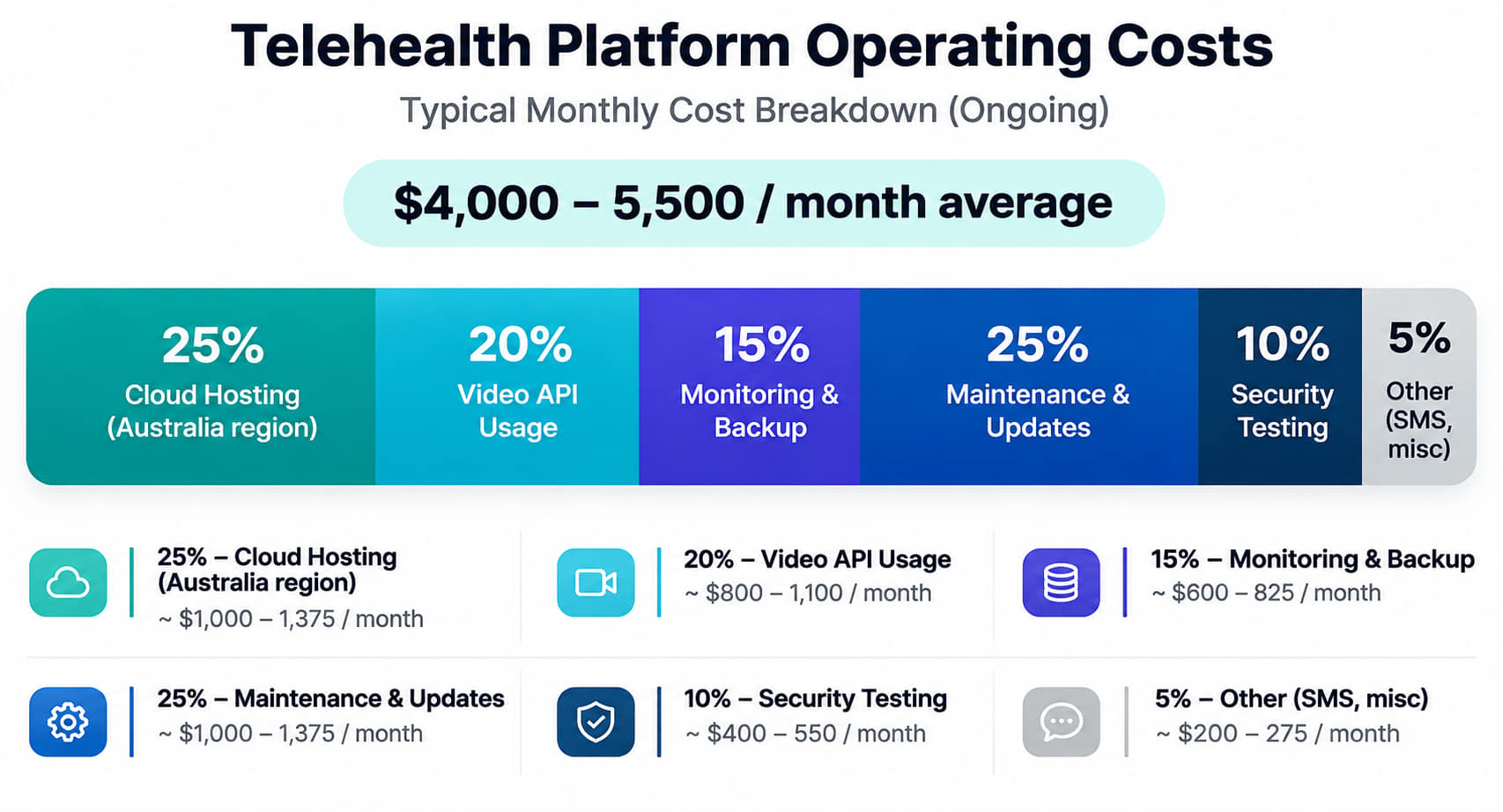
| Cost | Billing cycle | Indicative cost (AUD) | Basis |
|---|---|---|---|
| Cloud hosting in an Australian region | Monthly | $300 to $2,500 | Estimate; scales with users and environments |
| Video API usage | Monthly | $0.10 to $0.24 per 20-minute, two-person consult | Published per-minute rates, converted to AUD |
| SMS notifications | Monthly | Per-message fees | Varies by provider and volume |
| Monitoring, logging and backups | Monthly | $100 to $800 | Estimate |
| Maintenance and updates | Annual | 15% to 20% of the build cost | Appmart app development cost guide |
| Penetration testing | Annual | $10,000 to $30,000 | Estimate; depends on scope |
That annual 15% to 20% figure covers bug fixes, operating system updates, dependency upgrades and small feature changes. Appmart's app support and maintenance plans cover this work on a retainer so the platform does not drift out of date.
Reducing admin time is where most clinics recover these costs. Appmart has written before on why practice management is cost management for Australian clinics.
How Long Does It Take to Build Telehealth Software?
A basic telehealth web build takes about 10 to 16 weeks. Appmart's fuller MVP takes 16 to 24 weeks from scoping to launch, and enterprise platforms take 9 to 18 months.
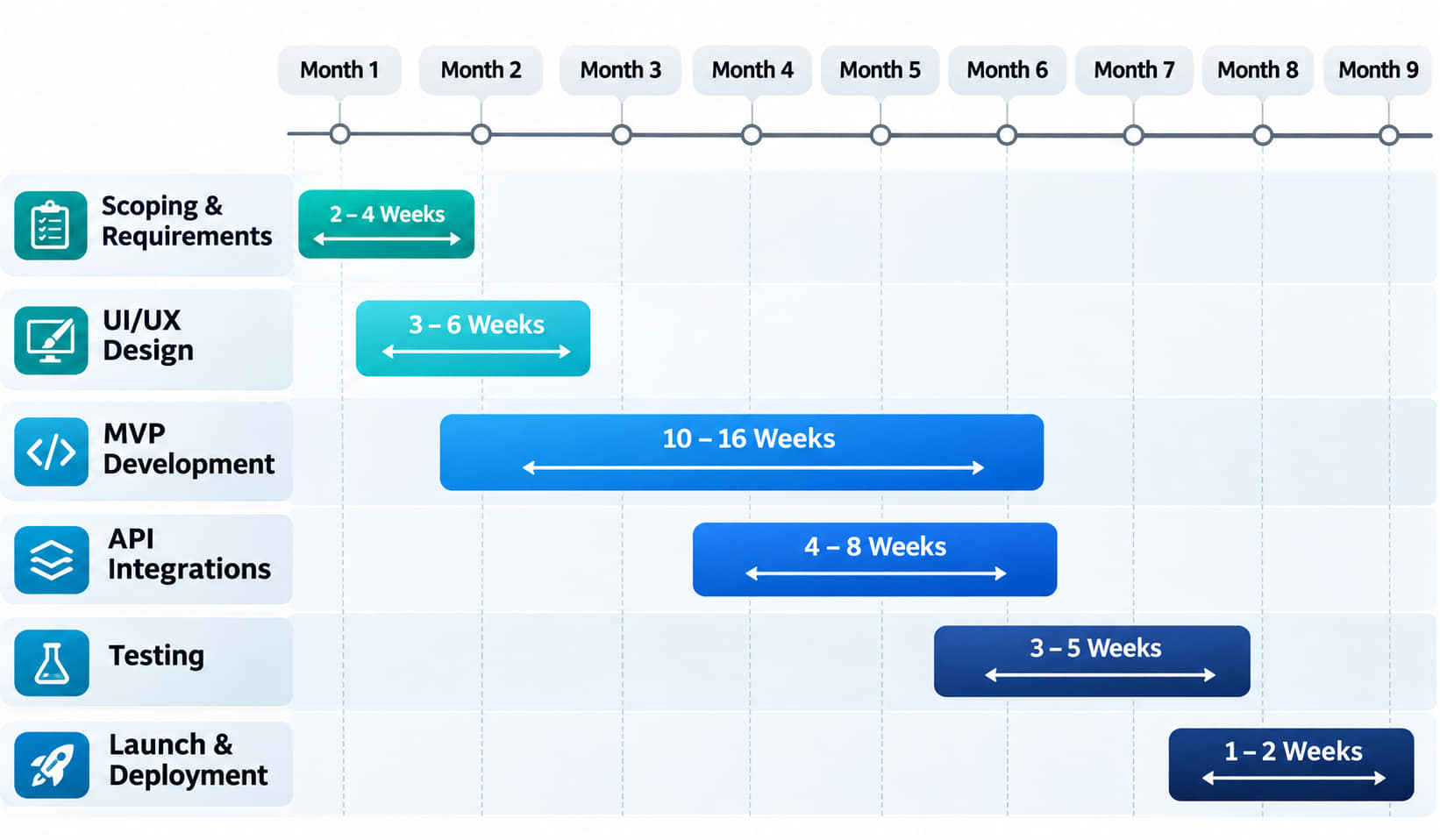
| Phase | Basic build | Mid-level platform | Advanced platform |
|---|---|---|---|
| Scoping | 1 to 2 weeks | 2 to 4 weeks | 4 to 8 weeks |
| UI/UX design | 2 to 3 weeks | 3 to 6 weeks | 6 to 10 weeks |
| MVP development | 5 to 8 weeks | 10 to 16 weeks | 16 to 30 weeks |
| Integrations | 1 to 2 weeks | 4 to 8 weeks | 8 to 20 weeks |
| Testing | 2 to 3 weeks | 3 to 5 weeks | 6 to 10 weeks |
| Launch | 1 week | 1 to 2 weeks | 2 to 4 weeks |
| Total (phases overlap) | 10 to 16 weeks | 4 to 9 months | 9 to 18 months |
How Can Clinics Reduce Telehealth Software Development Costs?
Start With an MVP
Launch with the smallest feature set that lets clinicians run real consults. Real usage then shows which feature deserves the next dollar, and it is often something unexpected, such as intake forms.
Prioritise Essential Integrations
Rank every planned integration by staff time saved per week, then build the top one or two first. If a manual step takes a few minutes a day, leave it manual until volume makes that time expensive.
Use Existing Video Infrastructure
A proven video API gives you encryption, relay servers for restrictive networks and mobile toolkits from day one. You pay per minute instead of funding months of real-time media engineering. If data location matters, choose a provider with an Australian media region.
Build Custom Telehealth Software With Appmart
Speak with Appmart's healthcare app team in South Melbourne.
Appmart designs and builds web and mobile apps for Australian healthcare providers, covering patient, clinician and admin apps, with case studies such as Aesthetik Dental, MPGo and Carer's Notebook. For telehealth, Appmart scopes secure video, MBS billing logic, electronic prescribing integrations and FHIR connections.
Every project starts with a free scoping call and a fixed-price proposal. If a subscription tool suits your clinic better, Praharsh Parikh and the team will tell you so.
Discuss Your Telehealth ProjectRead more about telehealth app development in Australia, explore Appmart's healthcare app development services, or see its wider custom software development work.
Telehealth Software Cost FAQs
Custom telehealth software costs about $30,000 to $350,000 or more to build, excluding GST. A basic web build costs $30,000 to $70,000, and a mid-level platform $70,000 to $150,000. Advanced platforms start at $150,000. Subscription tools range from free for eligible practices to around $120 per clinician a month.
Most custom projects cost $70,000 to $150,000 once they include mobile apps, payments and practice software integration. Integration-light web builds can start near $30,000. Platforms with My Health Record, HL7 or FHIR connections usually exceed $150,000. These figures are indicative estimates, not quotes.
Published subscription prices run from $0 to about $120 per clinician a month. Healthdirect Video Call is free for general practices and Aboriginal health services. Coviu lists $40 to $99 per clinician a month on annual billing, excluding GST. AI scribes, phone lines and SMS add to the total.
Usually, yes, for a single practice. Ten clinicians on a $99 monthly plan cost about $35,640 over three years, less than a basic custom build with maintenance. The gap narrows for large teams, multi-site groups and businesses that sell telehealth as their main service.
A basic web build takes about 10 to 16 weeks. A fuller MVP with native apps takes 16 to 24 weeks. Enterprise platforms with My Health Record and device integrations take 9 to 18 months. Unclear requirements and conformance testing cause most delays.
Yes, when the clinic management system offers an API or partner program. Most integrations sync appointments, patient details and notes. Each one has its own cost, from a few thousand to tens of thousands of dollars, depending on the vendor's API and testing rules.
Yes. Telehealth software can record MBS item details and check telehealth eligibility rules before a claim. Direct claiming needs Services Australia web services, PRODA authentication and integration testing. Many platforms send claims through the clinic's practice software or a claiming partner instead, which costs less to build.
A telehealth MVP should include patient registration, appointment scheduling, secure video with a virtual waiting room and a clinician dashboard. Add SMS or email reminders, plus payments if you bill privately. Leave Medicare claiming, prescribing, My Health Record and remote monitoring for later, unless your service depends on them.
Budget 15% to 20% of the build cost each year for maintenance, based on Appmart's app development cost guide. A $70,000 platform therefore needs about $10,500 to $14,000 a year. Hosting, video usage, SMS fees and annual security testing sit on top of that figure.